

AI Interviewers Go Mainstream: Dayforce Buys Ribbon. Pricing, Candidate Reactions and the Rules to Follow (October 2026)

Prices and facts checked October 27, 2026. We don't accept payment for rankings.
On this page
What happened: on October 23, 2026, HR software company Dayforce agreed to acquire Ribbon AI, a Toronto startup whose AI runs two-way voice and video screening interviews around the clock (Dayforce release via The Manila Times). The price and closing date weren't disclosed. Ribbon will become part of a new "Dayforce Agentic Recruiting" experience.
Why it matters: AI interviewers are moving from startups into the big HR platforms employers already use. Candidates are already meeting them: in a Greenhouse survey, 63% of US job seekers said an AI had interviewed them. But 38% had walked away from a hiring process because of one (Greenhouse release).
If you're a recruiter or agency considering an AI interviewer, this guide covers what they do, what they cost, how candidates react, and the laws that apply.
What an AI interviewer does (using Ribbon as the example)
Per the acquisition announcement, Ribbon:
- writes the interview from your job description: it generates questions and a scoring rubric, drawing on relevant past interviews
- runs the interview by voice or video, any time of day, as a two-way conversation rather than a recorded one-way video
- scores candidates from the transcript
- runs "integrity checks" that flag unusual audio, gaze and response-timing patterns
- sources and re-engages candidates from your existing database, with outreach by SMS, WhatsApp and email
Dayforce says Ribbon has hundreds of customers and more than one million completed interviews. About 90% of customers use its recommended default setup (Dayforce release via The Manila Times). Ribbon was founded in 2022 and raised $8.2 million in early 2025, led by Radical Ventures (BetaKit).
What AI interviewers cost: Ribbon's pricing
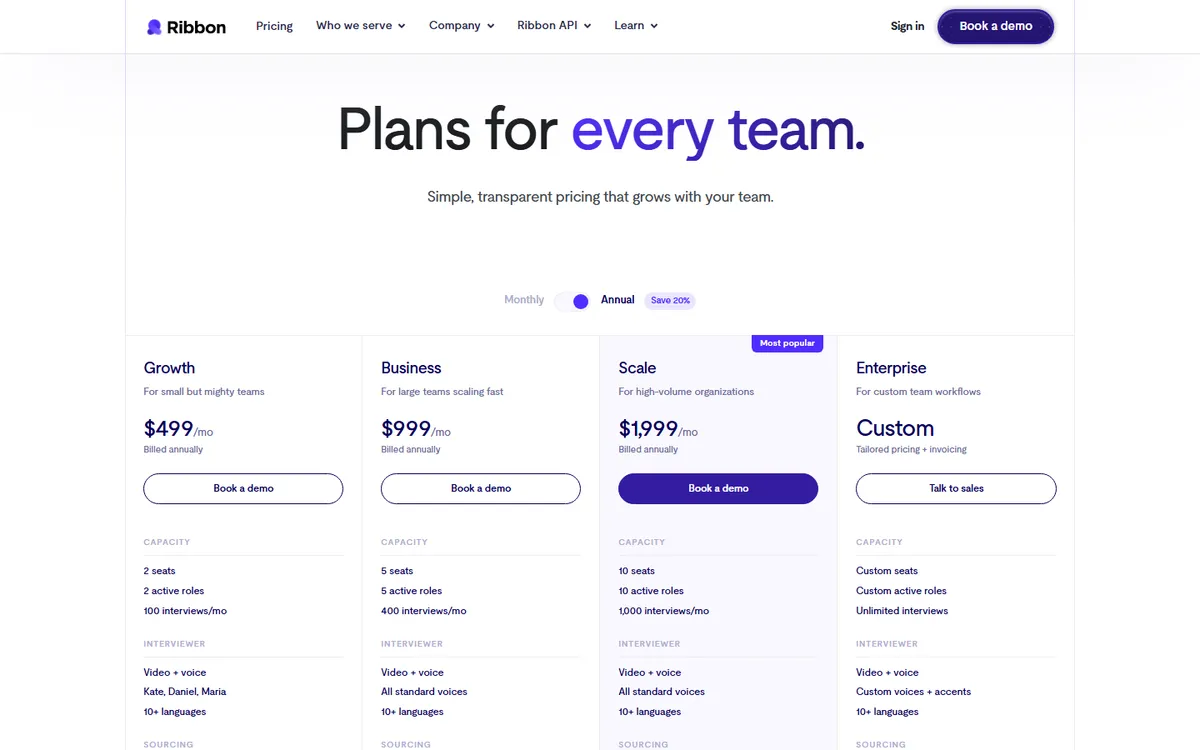
Ribbon is unusual in publishing its prices. As of October 27, 2026 (Ribbon pricing):
| Plan | Billed monthly | Billed annually (per month) | Seats / active roles | Interviews a month | Extra interviews |
|---|---|---|---|---|---|
| Growth | $599 | $499 | 2 / 2 | 100 | $4.00 each |
| Business | $1,199 | $999 | 5 / 5 | 400 | $3.00 each |
| Scale | $2,399 | $1,999 | 10 / 10 | 1,000 | $2.50 each |
| Enterprise | Custom | Custom | Custom | Unlimited | — |
Every plan includes video and voice interviews in 10+ languages. The live page's buttons say "Book a demo", so expect a sales call before you start. Per interview, that works out to roughly $5 on Growth and $2 on Scale at annual rates, before overage.
Watch the "active roles" limit. An agency with 2 seats on Growth can only run interviews for 2 open roles at once, so a busy desk may need a bigger plan than its interview volume suggests. Pricing may change after the Dayforce deal closes.
How candidates feel about AI interviews
Greenhouse surveyed 2,950 job seekers, including 1,200 in the US. The figures below are for US respondents (Greenhouse release):
| Finding | US candidates |
|---|---|
| Have been interviewed by an AI | 63% (up 13 points in six months) |
| Left a hiring process because it included an AI interview | 38% (another 12% say they would) |
| Weren't clearly told up front that AI would evaluate them | 70% |
| Never heard back after an AI interview | 51% |
| Want the option to ask for a human interviewer | 46% |
| Want upfront disclosure | 44% |
| Want a human to review AI evaluations before any decision | 38% |
| Came away more positive about the employer when it was done well | 38% (34% more negative) |
Only 19% want less AI in hiring. Candidates mostly objected to how AI was used: no warning, no human, and no reply afterward. The top reasons for walking away were an AI-scored pre-recorded video with no human present (33%), undisclosed AI use (27%) and AI monitoring (26%).
Greenhouse sells hiring software and has its own AI interview approach, so read the survey with that in mind. The pattern still matches what candidates say elsewhere: tell them, explain it, and keep a person involved. See also our roundup of recruiter surveys on AI-polished resumes.
The rules that apply to AI interviews
Not legal advice. This summarizes laws as of October 27, 2026. Check with employment counsel for your states and your clients' states.
Illinois: AI Video Interview Act. If you use AI to analyze recorded video interviews for Illinois-based jobs, you must (820 ILCS 42):
- tell each applicant, before the interview, that AI may analyze the video
- explain how the AI works and the general types of characteristics it evaluates
- get the applicant's consent. You can't use AI to evaluate applicants who haven't consented
- share videos only with people whose expertise or technology is needed to evaluate the applicant
- delete videos within 30 days of an applicant's request, and tell anyone who received copies to delete them too, including backups
- report applicants' race and ethnicity to the state each year if you rely solely on the AI analysis to decide who gets an in-person interview
Illinois' broader law (HB 3773, in force since January 2026) also requires notice whenever AI is used in hiring decisions and bans discriminatory use. It's covered in our guide to AI hiring laws.
New York City: Local Law 144. If an AI tool substantially helps decide who advances, NYC requires a bias audit within one year before use, a public summary of the results, and notice to candidates 10 business days before use (NYC DCWP). An AI interviewer that scores candidates is likely to fall under this. Ask the vendor for its bias audit.
Other states. Colorado's replacement AI law (our guide), Connecticut's new law (our guide) and California's regulations (our guide) add notice, record-keeping or risk-assessment duties. Illinois also has a biometric privacy law. If a tool analyzes faces, voices or gaze, ask counsel whether it applies.
Agencies: if you run AI interviews for a client, agree in writing who gives notices, who holds the recordings and who answers deletion requests.
A checklist before you turn on an AI interviewer
- Disclose it up front. Say in the job ad or invitation that an AI will conduct the first interview, what it assesses, and how long it takes. This was candidates' biggest complaint.
- Offer a human alternative. Nearly half of candidates want one, and it also helps with disability accommodation requests.
- Keep a person on every rejection. Use AI scores to prioritize, not to reject automatically. Have a recruiter review before anyone is screened out.
- Ask about the "integrity checks." Find out exactly what gaze or audio flags trigger, how they're used in scoring, and whether a flag can reject someone on its own. Flags like these can unfairly hit candidates with disabilities or poor internet.
- Get the bias audit and data terms. Ask for the latest bias audit, where recordings are stored, how long they're kept, and whether they're used to train models.
- Always follow up. 51% of candidates never heard back after an AI interview. Set up an automatic status update so your employer brand doesn't take the hit.
- Pilot one high-volume role. Compare time-to-screen, drop-off and the quality of shortlisted candidates against your current process before you expand.
Will AI interviewers replace recruiters?
They replace the first phone screen, which is a big share of a high-volume recruiter's week. Recruiters still decide who gets hired, sell the role, negotiate offers and manage hiring managers. More in will AI replace recruiters? For tools that support human-led interviews instead, see our guide to AI interview note-takers.
FAQ
How much does an AI interviewer cost?
Ribbon, one of the few vendors with public pricing, charges $599 a month for 100 interviews on its Growth plan, or $499 a month billed annually. Its Scale plan is $1,999 a month billed annually for 1,000 interviews.
Do I have to tell candidates an AI is interviewing them?
In many places, yes. Illinois requires notice, an explanation and consent before AI analyzes video interviews, and NYC requires notice 10 business days before using a covered AI tool. Even where it isn't required, 70% of candidates in Greenhouse's survey said they weren't clearly told, and undisclosed AI was a top reason for walking away.
Can candidates ask for their AI interview video to be deleted?
In Illinois, yes. Employers must delete the videos within 30 days of the applicant's request, and must tell anyone they shared copies with to delete them too.
When will Ribbon be part of Dayforce?
The deal was announced October 23, 2026, and no closing date was disclosed. Ribbon will be built into a new Dayforce Agentic Recruiting experience after the deal closes.
Sources
Pages we used for this article, checked on or before the update date above.
- Dayforce release via The Manila Times · manilatimes.net
- Greenhouse release · digital-release.wboy.com
- BetaKit · betakit.com
- Ribbon pricing · ribbon.ai
- 820 ILCS 42 · codes.findlaw.com
- NYC DCWP · nyc.gov
Changelog: Oct 27, 2026: first published.