

Connecticut's AI Hiring Law: What Changed on October 1, 2026 and What Comes in 2027

Prices and facts checked October 15, 2026. We don't accept payment for rankings.

On this page
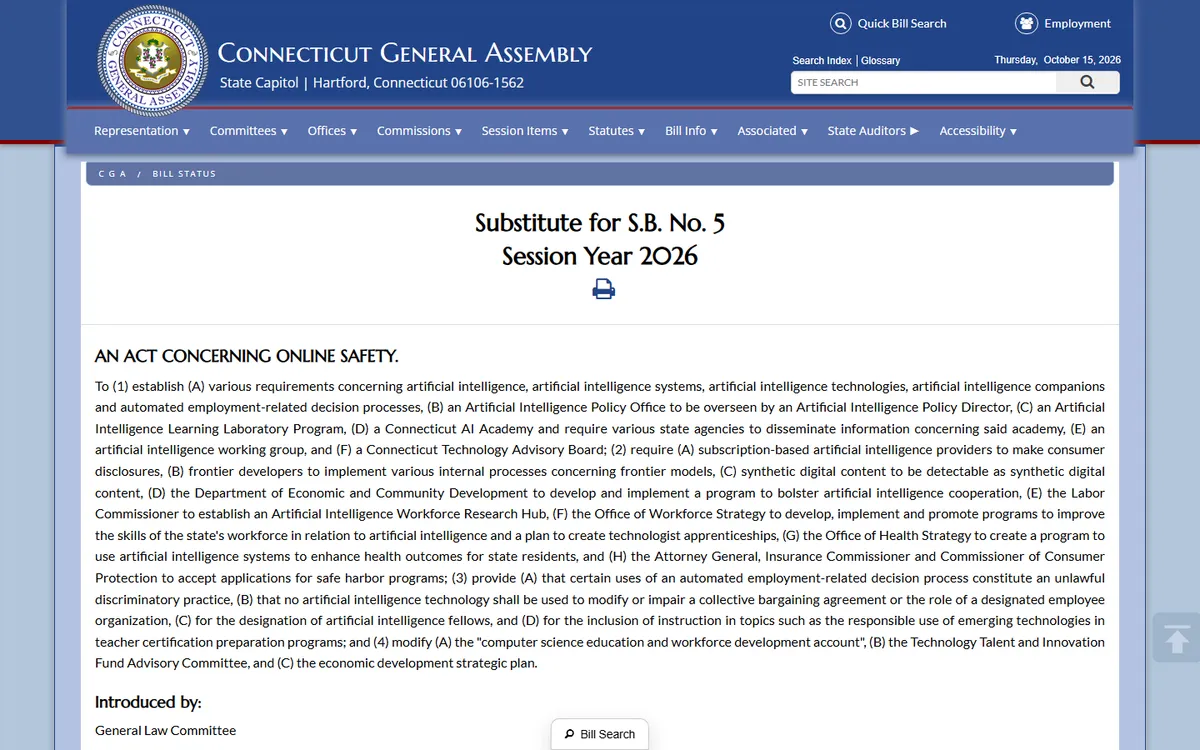
What happened: Connecticut's Artificial Intelligence Responsibility and Transparency Act, known as the CART Act (Public Act 26-15, SB 5), began taking effect on October 1, 2026. Two employment changes are already live:
- Relying on an AI hiring tool is no defense to a discrimination complaint.
- Employers filing WARN layoff notices must say whether AI or other technology contributed to the layoffs.
The bigger set of rules, including candidate notices for automated hiring tools, applies from October 1, 2027 (Silberman Law; Faegre Drinker).
Why it matters: if you source, screen or rank candidates for roles in Connecticut, and an AI tool's score or recommendation shapes the decision, you're already exposed. "The software decided" won't help you defend a discrimination complaint.
Not legal advice. Law firm summaries differ on some dates. Confirm against the enacted text of Public Act 26-15 and with employment counsel before relying on any date.
What's in force now and what's coming
| Date | What changes | Who it affects |
|---|---|---|
| October 1, 2026 | Use of an automated employment decision tool (AEDT) "shall not be a defense" to a discrimination complaint. Anti-bias testing can be weighed in your favor, but it isn't a safe harbor. | Employers and anyone deciding for them |
| October 1, 2026 | WARN notices must tell the Connecticut Department of Labor whether layoffs relate to AI or other technological change | Employers issuing WARN notices |
| Oct 1, 2026 – Dec 31, 2027 | Cure period: the Attorney General may allow 60 days to fix certain AEDT violations before suing | Employers and vendors |
| October 1, 2027 | Notice duties for tools deployed on or after this date: tell candidates and employees when they're interacting with an AEDT, and give written notice before a decision | Employers (deployers) and vendors (developers) |
Sources: Silberman Law; Faegre Drinker; WilmerHale. One firm's summary lists the AEDT framework itself as effective October 1, 2026, while the notice duties apply to tools deployed from October 1, 2027. The firms agree that the notice obligations are a 2027 deadline.
What counts as an "AEDT"
An automated employment decision tool is technology that processes personal data and produces a score, rank, classification or recommendation that's a "substantial factor" in an employment decision, meaning it meaningfully changes the outcome. Covered decisions include hiring, firing, promotion, discipline, renewal and selection for training (Silberman Law). Faegre Drinker lists resume screeners, hiring platforms, assessment tools, scheduling algorithms and performance analytics as examples.
For recruiters, that likely includes:
- AI candidate scoring or matching in your ATS
- AI screening interviews that rank candidates
- AI shortlists you rely on to decide who moves forward
AI that only drafts a job description or takes interview notes, without scoring candidates, is less likely to qualify. Check with counsel where the line falls for your tools.
The 2027 notice requirements
From October 1, 2027, deployers must, for tools deployed on or after that date (WilmerHale):
- Tell candidates and employees when they're interacting with an AEDT, in plain language, if it isn't obvious.
- Give written notice before a decision, covering the tool's use and automated role, its trade name, the categories and sources of personal data, and a contact.
Vendors must give employers the information they need to comply, or take on the duties by contract. Enforcement is by the Attorney General, and there's no private right of action for AEDT violations. Faegre Drinker notes an affirmative defense for organizations that find and cure a violation within 60 days and follow a recognized framework such as the NIST AI Risk Management Framework or ISO/IEC 42001.
What recruiters should do now
- List every tool that scores, ranks or recommends candidates for Connecticut roles.
- Ask each vendor for bias-testing documentation. Courts and the Commission on Human Rights and Opportunities can weigh "the quality, efficacy, recency and scope" of anti-bias testing (Faegre Drinker).
- Keep a human decision-maker who can explain each hiring decision without pointing to the tool.
- Update vendor contracts for the 2027 notice duties: who drafts the notices, and who supplies the data categories.
- Draft your candidate notice now. If you also hire in New York City, Illinois or Colorado, one notice can often be adapted for all of them.
Connecticut joins a growing list. Compare it with New York City, Illinois and Colorado, Colorado's SB 26-189 and California's ADMT rules. And if your stack scores candidates, see how the tools compare in best AI ATS for agencies.
Beyond hiring
The CART Act also covers AI subscription disclosures, whistleblower protections at frontier AI developers, and chatbot rules for AI companions (from January 1, 2027) (Daily Campus). A companion law, Public Act 26-64, adds data broker, genetic data and facial recognition rules from October 1, 2026 (CT Mirror).
FAQ
Does Connecticut require AI bias audits for hiring?
No. Unlike New York City's Local Law 144, the CART Act doesn't require audits. But anti-bias testing can count in your favor if a discrimination complaint is filed.
Do I need to notify candidates about AI right now?
Not under the CART Act's AEDT notice rules, which apply from October 1, 2027. But the discrimination change is already in force, so documenting your process now is wise.
Does this apply to staffing agencies outside Connecticut?
The rules focus on decisions about individuals in Connecticut. If you recruit for Connecticut roles or candidates, assume they apply and confirm with counsel.
Sources
Pages we used for this article, checked on or before the update date above.
- Silberman Law · silbermanlawpc.com
- Faegre Drinker · faegredrinker.com
- Read the bill · cga.ct.gov
- WilmerHale · wilmerhale.com
- Daily Campus · dailycampus.com
- CT Mirror · ctmirror.org
Changelog: Oct 15, 2026: first published.