

AI Hallucination Sanctions: The Cases Every Lawyer Should Know (2025–2026)

Prices and facts checked October 13, 2026. We don't accept payment for rankings.
On this page
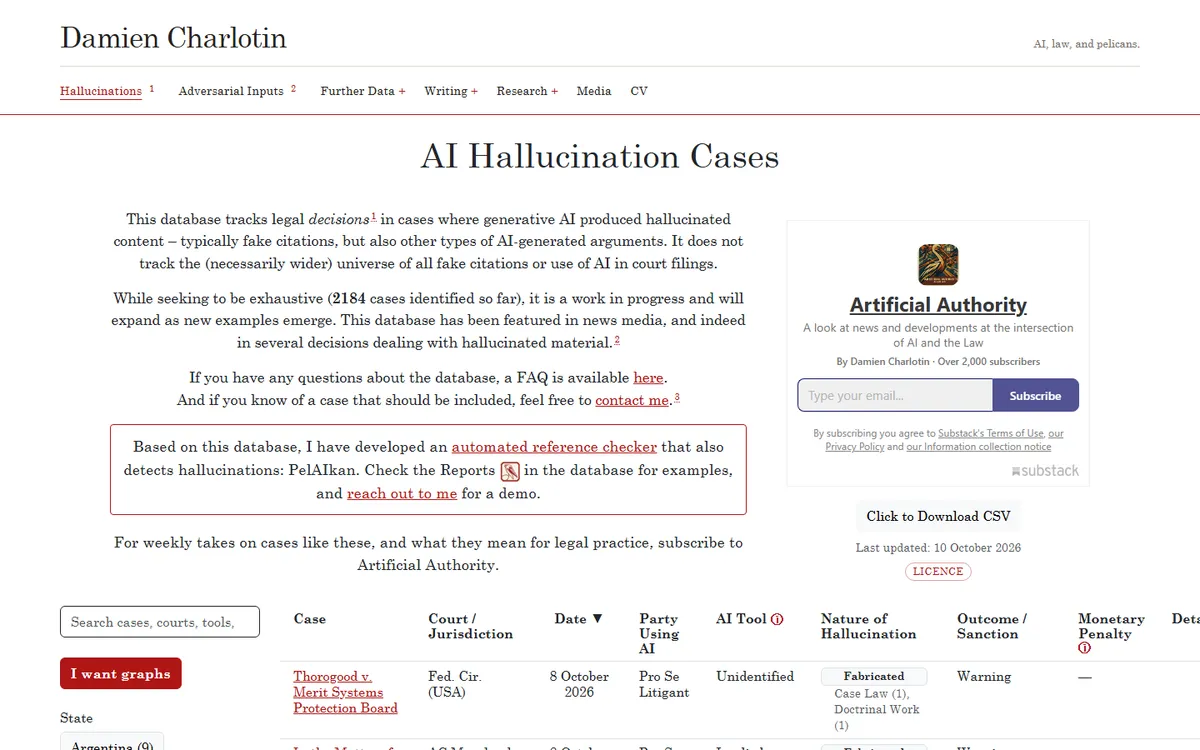
What happened: fake AI-generated citations stopped being a curiosity and became a sanctions trend. A researcher's public database now lists more than 2,000 court decisions involving AI-fabricated content (AI Hallucination Cases Database). Through 2025, penalties escalated from modest fines to disqualification, bar referrals and five-figure sanctions.
Why it matters today: courts have made clear that "the AI did it" isn't a defense, and that everyone who signs a filing owns its citations. In California, that duty becomes statute on January 1, 2027 (our SB 574 explainer).
The cases
| Case | Court and date | What happened | Consequence |
|---|---|---|---|
| Wadsworth v. Walmart (Morgan & Morgan) | D. Wyo., Feb 24, 2025 | Motion in limine cited 8 nonexistent cases from the firm's AI tool | Drafter fined $3,000 and pro hac vice revoked; two signers fined $1,000 each |
| Coomer v. Lindell (MyPillow) | D. Colo., Jul 7, 2025 | Brief with nearly 30 defective citations | $3,000 each for two lawyers; "draft filed by mistake" explanation rejected |
| Johnson v. Dunn (Butler Snow) | N.D. Ala., Jul 23, 2025 | ChatGPT citations in two discovery motions | Public reprimand, disqualification, state bar referral, order sent to clients and judges |
| Noland v. Land of the Free | Cal. Ct. App., Sep 2025 | 21 of 23 quotations fabricated | $10,000 sanction payable to the court, bar referral, published opinion |
Sources: Bloomberg Law; ABA Journal; EDRM; Proskauer; Rev.
Five lessons from the rulings
1. Signing is certifying
The Wyoming court said a lawyer who signs certifies a reasonable inquiry into the law, regardless of the tools used. The two signers who didn't draft the motion were still fined (Bloomberg Law).
2. Fines weren't working, so courts escalated
In Johnson v. Dunn, Judge Manasco said reprimands and modest fines hadn't deterred the problem, and imposed individual sanctions, including disqualification and a bar referral (EDRM).
3. A good firm policy protects the firm, not the lawyer
Butler Snow had an AI policy since June 2023 requiring approval and verification, and the court didn't sanction the firm. The firm then had outside counsel review 2,400+ citations across 330 filings. The individual lawyers were still sanctioned (EDRM). Morgan & Morgan avoided firm sanctions the same way (Bloomberg Law).
4. Explanations get tested
In Coomer v. Lindell, the court reviewed Word drafts and emails, then rejected the "wrong draft" story for "contradictory statements and the lack of corroborating evidence" (ABA Journal).
5. Not knowing AI hallucinates is no excuse
In Noland, counsel said he didn't know AI could fabricate sources. The court found the appeal frivolous and refused revised briefs. It also found the fakes itself: opposing counsel hadn't flagged them (Proskauer).
A verification workflow that would have prevented every case
- Pull every authority from a citator (Westlaw, Lexis, vLex, Fastcase), not from the AI's answer.
- Read the cited passage and confirm the quotation exists, word for word.
- Check the holding supports the proposition, not just that the case exists.
- Log who verified each citation, with initials in your cite-check table.
- Treat partner sign-off as a real review, not a formality.
- Use AI tools grounded in a legal database for research, and still verify.
Ethics rules require the same thing. See ABA Formal Opinion 512, and compare research tools in our small-firm AI guide.
FAQ
Can a firm be sanctioned for one lawyer's AI misuse?
Courts have so far spared firms with real AI policies and quick remediation, while sanctioning the individuals involved.
Do I have to disclose AI use to the court?
It depends on the court. Many judges have standing orders, and California's SB 574 adds a disclosure duty for filings from 2027. Check local rules.
Are legal-specific AI tools safe from hallucinations?
They reduce the risk but don't remove it. Verification is still required.
Sources
Pages we used for this article, checked on or before the update date above.
- AI Hallucination Cases Database · damiencharlotin.com
- Bloomberg Law · news.bloomberglaw.com
- ABA Journal · abajournal.com
- EDRM · edrm.net
- Proskauer · calemploymentlawupdate.proskauer.com
- Rev · rev.com
Changelog: Oct 13, 2026: first published.