California's AI Hiring Rules, One Year On: What Recruiters Must Do

Prices and facts checked October 13, 2026. We don't accept payment for rankings.
On this page
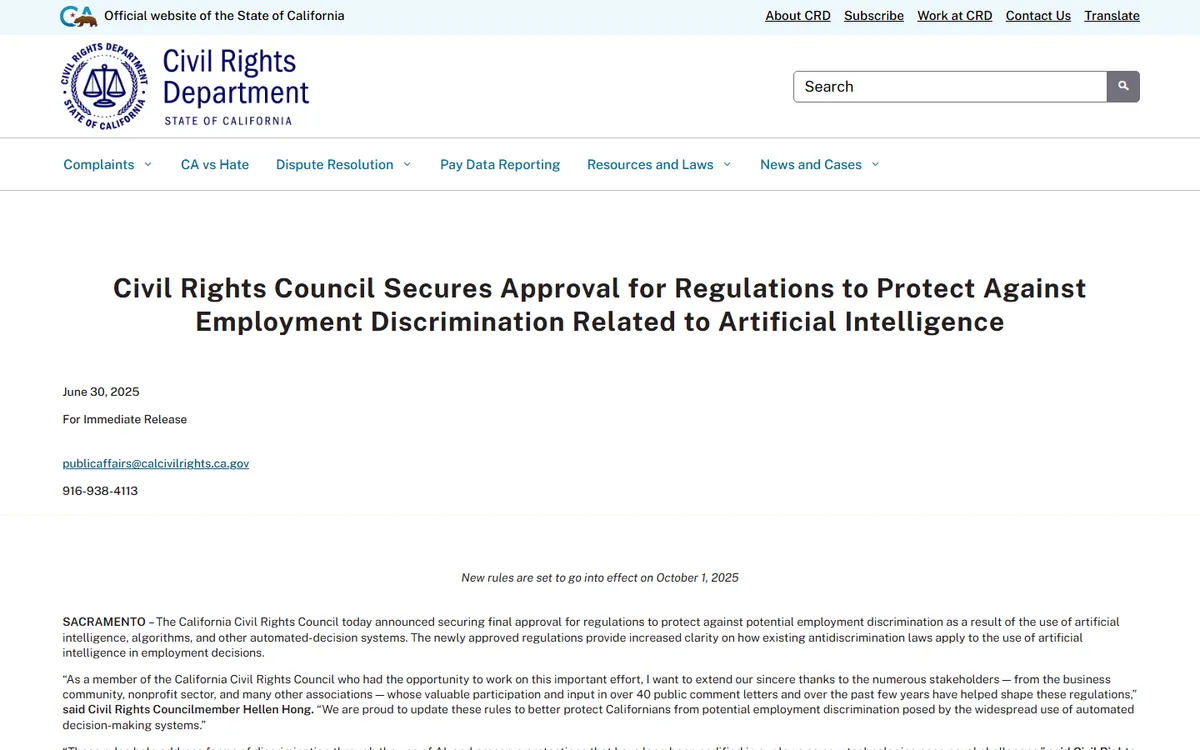
What happened: on October 1, 2025, California's Civil Rights Council regulations on automated-decision systems (ADS) in employment took effect. The state's Office of Administrative Law approved them on June 27, 2025, and the Civil Rights Council announced final approval on June 30 (California Civil Rights Department). They apply the Fair Employment and Housing Act (FEHA) to AI and algorithmic tools used in recruiting, hiring and promotion (Paul Hastings).
Why it matters a year later: this is the rule most recruiters are already working under, because California is the biggest hiring market in the US. It's also the one that most clearly reaches agencies and staffing firms, not just employers.
Not legal advice. This summarizes law-firm analysis of the regulations. Have employment counsel review how they apply to your desk and your clients.
What counts as an "automated-decision system"
An ADS is any computational process that makes, or helps a person make, a decision about an employment benefit. That includes AI, machine learning, algorithms and statistics. Examples in the regulations include (Paul Hastings):
- resume screening
- targeted job advertising
- skills tests and games
- analysis of facial expressions or voice in interviews
- analysis of third-party data about candidates
Basic tools like spreadsheets and spellcheckers aren't covered unless they make employment decisions. And keeping a human in the loop doesn't take you out of scope: the rules cover tools that facilitate human decisions (Mayer Brown).
Why recruiters are directly covered

The regulations define an employer's "agent" broadly, including third parties hired to recruit and screen applicants, and treat agents as employers under FEHA (Proskauer). If your agency sources, screens or ranks candidates for a California client using AI, assume the rules apply to you, not just your client.
AI vendors may face liability too, when an employer delegates an employment decision to their tool (Paul Hastings).
The four obligations that change your workflow
| Requirement | What it means in practice |
|---|---|
| No discriminatory impact | An ADS can violate FEHA through disparate impact on protected groups (race, age, disability, gender and others), even without intent |
| Keep records for 4 years | Employment records rise from two to four years, including ADS data: inputs, outputs, and data used to customize the tool (Proskauer) |
| No hidden medical inquiries | Tests, questions or games likely to reveal a disability can count as a prohibited pre-offer medical inquiry |
| Bias testing counts | Testing isn't mandatory, but documented anti-bias testing, and how you responded to results, can support a defense; its quality, recency and scope may be weighed (Mayer Brown) |
A recruiter's checklist
- List every AI feature you use on California roles: sourcing filters, match scores, auto-rejections, interview analysis.
- Separate "find" from "decide." Finding and messaging candidates is lower risk. Scoring, ranking or rejecting is where the rules bite.
- Ask vendors for bias testing and keep the results. Testing evidence is part of your defense.
- Extend retention to four years for candidate data, AI outputs and decisions.
- Offer accommodations where an assessment could disadvantage candidates with disabilities, such as timed skills tests or tools that analyze voice or facial expressions (Mayer Brown).
- Agree responsibilities with clients in writing: who validates the tool, who keeps records.
New York City requires annual bias audits for automated employment decision tools (NYC DCWP), and Illinois has required notice of AI use in hiring since January 1, 2026 (Fisher Phillips). See our guide to AI hiring laws, and for hiring in Europe, the EU AI Act's new 2027 deadline. Choosing tools? Compare AI sourcing tools for recruiters.
FAQ
Does a human making the final call avoid the rules?
No. The regulations cover systems that help humans make decisions, not only fully automated ones.
Do I need to run bias audits?
California doesn't mandate them, unlike New York City's audit requirement. But testing, and what you did with the results, is relevant evidence if a claim is brought.
What records do I need to keep?
Personnel and employment records for at least four years, including ADS data: data about applicants, the tool's outputs and decisions, and data used to build or customize the tool for that employer.
Sources
Pages we used for this article, checked on or before the update date above.
- California Civil Rights Department · calcivilrights.ca.gov
- Paul Hastings · paulhastings.com
- Mayer Brown · mayerbrown.com
- Mina Rad · unsplash.com
- Proskauer · proskauer.com
- NYC DCWP · nyc.gov
- Fisher Phillips · fisherphillips.com
Changelog: Oct 13, 2026: first published.