

The IRS's First AI Guidelines for Tax Pros, and the AICPA's Fight Over Fees

Prices and facts checked October 13, 2026. We don't accept payment for rankings.

On this page
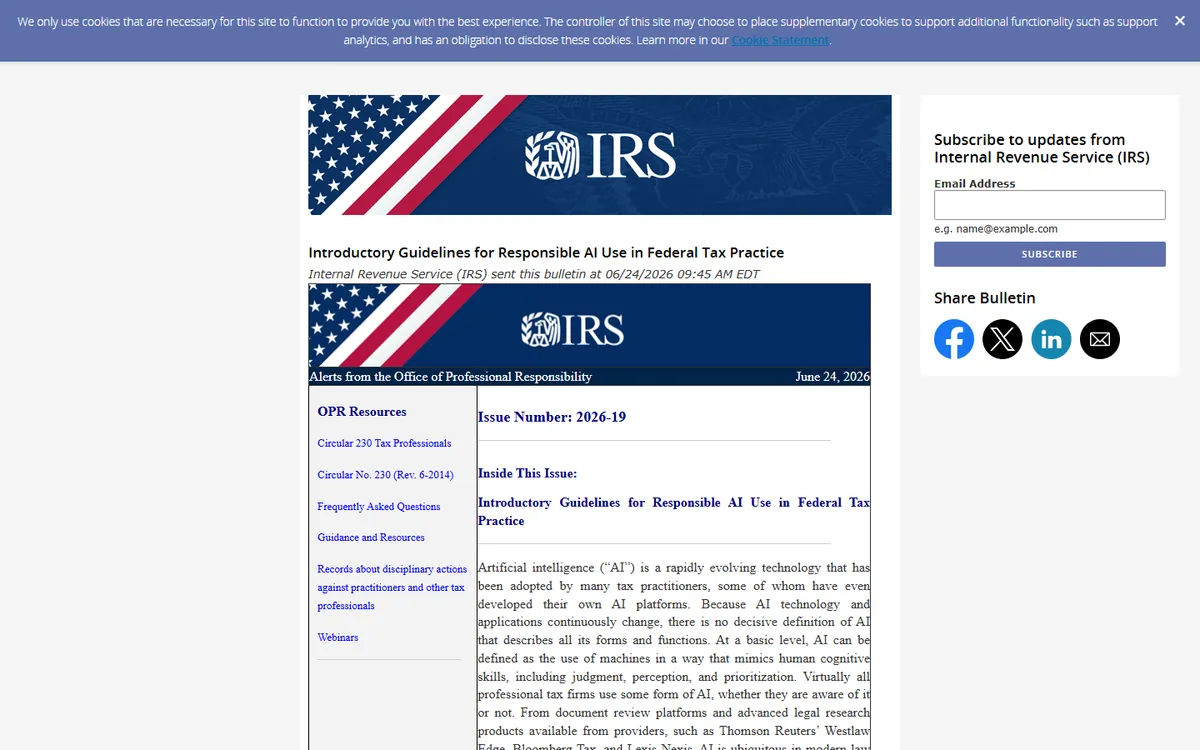
What happened: on June 24, 2026, the IRS Office of Professional Responsibility issued Alert 2026-19, "Introductory Guidelines for Responsible AI Use in Federal Tax Practice", its first formal guidance on how Circular 230 applies to AI (IRS OPR). In September 2026, the AICPA pushed back on one part: language suggesting practitioners should pass AI efficiencies on to clients through lower fees (The Tax Adviser, Sep 8, 2026).
Why it matters today: filing season prep starts now. Firms need written AI procedures before AI tools touch 2026 returns, and Circular 230 §10.36 puts that on firm leadership.
Not legal advice. The Alert applies existing Circular 230 rules; it doesn't create new ones. Discuss specifics with your firm's counsel or ethics adviser.
What the Alert says, section by section
| Circular 230 | What OPR expects with AI |
|---|---|
| §10.35 Competence | Understand how your AI tools generate content, their limits and their risks of bias and error |
| §10.22 Due diligence | Review all AI content before it reaches a client or the IRS; verify facts, citations and calculations. "Practitioners cannot rely solely on AI" |
| Confidentiality | Use only secure, enterprise-approved AI. "Never upload sensitive data to unsecured sites." Misuse can trigger penalties under IRC §§6713 and 7216 |
| §10.37 Written advice | Independently verify AI-supplied facts and authorities; reliance on opaque AI logic may be unreasonable |
| §10.27 Fees | No unconscionable fees; billing for time not spent, or double-billing AI work, may violate it |
| §10.36 Firm procedures | Leaders must ensure procedures covering training, secure data handling, accuracy monitoring and vetting third-party AI tools |
Source: IRS OPR Alert 2026-19. OPR also cited court sanctions against lawyers for AI-fabricated citations as a warning (Thomson Reuters).
The fee fight
OPR's guidance says practitioners should disclose AI use and pass cost savings on to clients. The AICPA objected:
- It doesn't allow for value pricing, which is how many firms bill.
- It ignores AI's costs: licenses, implementation, governance and training.
- AICPA's Eva Simpson called it "an overly simplistic view that ignores the full economics of AI adoption."
- CEO Mark Koziel said the language isn't authoritative and could be "overstepping a little bit."
The AICPA is working with the IRS on clarifying language and FAQs (The Tax Adviser).
Practical middle ground: the clear risk is billing hours you didn't work. Fixed or value pricing agreed in advance is a different question from hourly billing for time AI saved. Make sure your engagement letters say which you use.
The consent question nobody has answered
The IRS hasn't said whether sending return information to an AI tool counts as a third-party disclosure under §7216. Until it does, one CPA consultant recommends a standalone signed AI consent drafted with counsel, plus a no-AI path for clients who decline, since conditioning services on consent can make it involuntary (CPA Practice Advisor, Oct 12, 2026). Our guide to §7216 and AI covers the consent rules.
Your pre-season checklist
- Approve specific AI tools in writing and block the rest for client data.
- Check each vendor's terms for your plan: training on data, retention, and whether zero-retention covers the chat app or only the API.
- Prevent cross-client leakage: work for one client can't draw on another's files.
- Log AI use per return: which tool, and who reviewed the output.
- Review everything before it reaches a client or the IRS.
- Update engagement letters for AI use and your billing method.
- Name an owner for the AI policy and review it annually (Kilpatrick Townsend).
Choosing research tools? See AI tax research tools compared.
FAQ
Is the OPR Alert binding?
It's guidance on existing Circular 230 rules, which are binding. The Alert itself doesn't add new rules.
Do I have to cut fees because I use AI?
The Alert's wording suggests passing savings on, but the AICPA disputes that for value pricing. Never bill for time not spent; beyond that, watch for the clarification the AICPA is seeking.
Is ChatGPT "enterprise-approved"?
Only if your firm has vetted and approved a specific plan with appropriate data terms. Consumer accounts generally aren't suitable for return information.
Sources
Pages we used for this article, checked on or before the update date above.
- IRS OPR · content.govdelivery.com
- The Tax Adviser, Sep 8, 2026 · thetaxadviser.com
- Thomson Reuters · tax.thomsonreuters.com
- CPA Practice Advisor, Oct 12, 2026 · cpapracticeadvisor.com
- Kilpatrick Townsend · ktslaw.com
Changelog: Oct 13, 2026: first published.