

The FDA Wants Comments on Generative AI Devices by October 19. What It Means for AI Therapy

Prices and facts checked October 16, 2026. We don't accept payment for rankings.
On this page
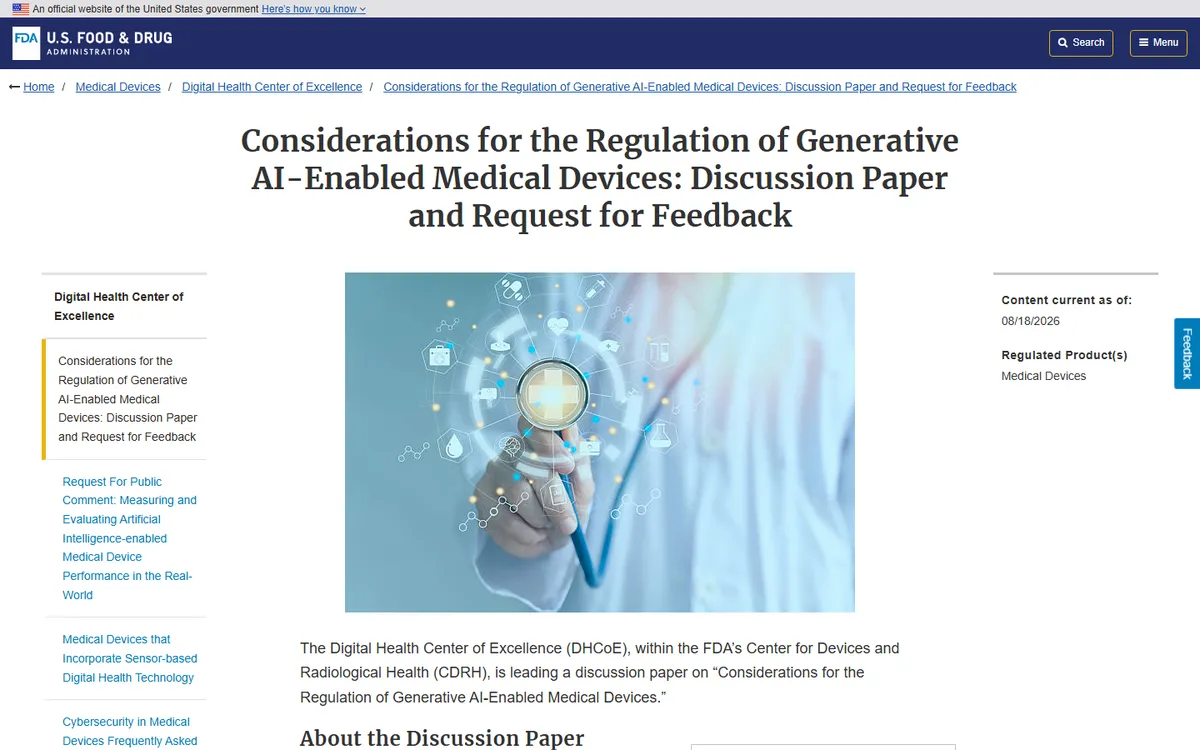
What's happening: the FDA's public comment period on a discussion paper about regulating generative AI-enabled medical devices closes on October 19, 2026 (docket FDA-2026-N-7874). The paper isn't draft guidance, but it sets out how the FDA is thinking about evidence and monitoring for devices built on large language models (FDA).
Why therapists should care: "AI therapists" are exactly the kind of product this framework could cover. The FDA's Digital Health Advisory Committee already spent a full meeting on generative AI digital mental health devices. Its CDRH director noted then that more than 1,200 AI devices had been authorized, but none using generative AI for mental health conditions (FDA advisory committee summary).
Not legal or regulatory advice. The discussion paper sets no new rules. Apps that only support wellness, or that help with clinical paperwork, generally aren't medical devices. Device status depends on a product's intended use.
What the FDA's discussion paper proposes
| Element | What the FDA floated |
|---|---|
| Risk framework | Two axes: how independently the AI acts (from non-directive information, up to fully autonomous action) and how severe a wrong output could be |
| Premarket evidence | A "competency" approach, like credentialing a clinician: benchmark testing across safety, clinical proficiency, generalizability and agentic conduct, then clinical confirmation (from retrospective review up to prospective studies) |
| Postmarket monitoring | Whether to accept more premarket uncertainty in exchange for continuous monitoring: re-benchmarking, clinician review of real-world outputs, drift detection |
| Model changes | How to handle a vendor changing the underlying foundation model |
| Questions | 26 numbered questions. Partial responses are welcome. |
Sources: FDA press release; FDA discussion paper page; Innolitics.
For an AI therapy chatbot, the framework points one way: a tool that talks to patients on its own about a psychiatric condition sits toward the high-autonomy, high-consequence corner, where the FDA would expect the strongest evidence.
What the FDA's advisers said about AI therapy
At its November 6, 2025 public meeting (FDA meeting page), the Digital Health Advisory Committee examined a hypothetical prescription LLM therapy device for adults with major depressive disorder (FDA):
- Benefits: earlier and broader access to therapy, symptom monitoring and triage, and particular value in rural and under-resourced areas.
- Risks: hallucinations, confabulations, data drift, model bias, and the device missing therapeutic cues a human therapist would catch.
- Safeguards: a full clinician evaluation before prescribing, a plan for symptom escalation, and a "single tap" button in the app to escalate to more support, including emergency services.
- Labeling: clearly state that the AI is not a human therapist, with overuse warnings, crisis information and data-privacy details.
- Over-the-counter use: the committee was more comfortable with treating mild symptoms. It had greater concern about moderate to severe depression and about autonomous diagnosis without a clinician, and flagged the risk of unhealthy parasocial relationships with chatbots.
How this fits with the state laws
Federal device rules and state practice laws are separate layers:
- States are restricting AI from delivering therapy at all. Illinois, Nevada and others ban it, and Colorado, Maine and others have added their own rules (state AI therapy laws; chatbot law map).
- The FDA is working out what evidence an AI mental health medical device would need to be authorized.
The likely direction: AI that supports clinicians (notes, measurement, between-session tools under a clinician's care) faces lighter requirements. Autonomous AI "therapists" face both state bans and a high federal evidence bar.
What therapists can do now
- Comment by October 19 if you have a view. Clinicians are explicitly invited, and you can answer only the questions that fit your experience. Search docket FDA-2026-N-7874 on Regulations.gov.
- Check what your clients use. Ask at intake whether clients use AI chatbots for emotional support. The advisory committee flagged parasocial attachment as a real risk.
- Keep your own AI tools in the "support" lane. AI note-takers are documentation tools, not therapy. They still need a BAA and client consent (consent form template; best AI progress notes).
FAQ
Is the FDA regulating AI therapy apps now?
Not through new rules yet. The discussion paper is a request for feedback, not guidance. Products intended to diagnose or treat a psychiatric condition can already be medical devices under existing law.
Has the FDA approved any AI therapist?
As of the November 2025 advisory meeting, the FDA said it had authorized no generative AI devices for mental health conditions.
Do AI note-takers for therapists need FDA approval?
Tools that only help with documentation generally aren't treated as devices for diagnosis or treatment. They still need HIPAA safeguards and, in many states, client consent.
Sources
Pages we used for this article, checked on or before the update date above.
- FDA · fda.gov
- FDA advisory committee summary · fda.gov
- FDA discussion paper page · fda.gov
- Innolitics · innolitics.com
- FDA meeting page · fda.gov
Changelog: Oct 16, 2026: first published.