

AI Made Sourcing Faster. Recruiters Trust Candidates Less. What 2 New Surveys Say (October 2026)

Prices and facts checked October 19, 2026. We don't accept payment for rankings.
On this page
What happened: two recruiter surveys published this month tell the same story.
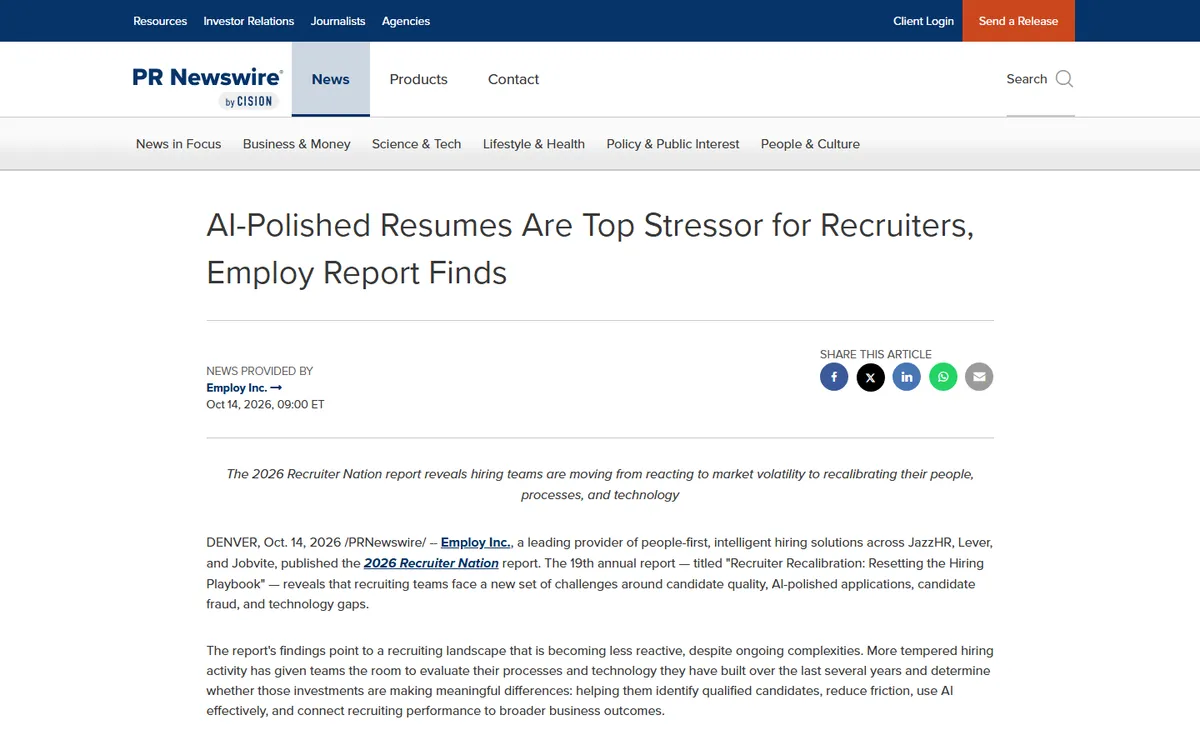
- Employ's 2026 Recruiter Nation report (October 14): for the first time in the study's 19 years, AI is recruiters' biggest stressor. 33% named AI-polished resumes as their top source of stress, ahead of a lack of qualified candidates (Employ via PR Newswire).
- TestGorilla's survey (October 16–19): 72% of US recruiters say AI made finding candidates faster. But about a third of them gained no confidence that they're finding the right person, and 18% said their confidence fell (HR Dive).
Why it matters: AI has made reach cheap on both sides. Recruiters can source more people, and candidates can produce polished, keyword-matched resumes in seconds. The bottleneck has moved from finding candidates to trusting them.
The numbers side by side
| Finding | Figure | Source |
|---|---|---|
| AI-polished resumes are the top stressor | 33% (first time AI tops the list in 19 years) | Employ |
| Organizations with confirmed AI-driven candidate fraud | 27%, up from 23% in 2025 | Employ |
| Recruiters who say AI made sourcing faster | 72% | TestGorilla |
| ...of whom gained no confidence in candidates | about 1 in 3 | TestGorilla |
| ...of whom say confidence fell | 18% | TestGorilla |
| Spend 1+ hour manually checking a single candidate | 67% of faster-sourcing recruiters | TestGorilla |
| Top sourcing challenge: verifying resume skills are real | 57% | TestGorilla |
| Would run an objective skills check before interviewing, if they could | 92% | TestGorilla |
| Use AI alongside their recruiting software | 68% | Employ |
| Have formal guidelines for recruiter AI use | 47% (30% developing them) | Employ |
| Have guidelines for candidate AI use | 44% | Employ |
| Applications per hire since 2021 | Tripled, to 300+ per hire | Ashby |
Sources: Employ via PR Newswire; TestGorilla via Business Wire; Ashby via PR Newswire.
How the surveys were run: Employ surveyed more than 1,200 US recruiters and HR managers through Zogby Analytics in August 2026. TestGorilla surveyed 1,428 US talent professionals, also in August 2026. Both companies sell recruiting software (an applicant tracking platform and a skills-testing platform), so read their conclusions with that in mind. The numbers still line up with each other and with Ashby's data on application volume.
Why AI made the trust problem worse
- Volume: Ashby's analysis of 100 million+ applications found applications per hire have tripled since 2021, and candidates are about 50% less likely to get an interview than five years ago (Ashby via PR Newswire).
- Sameness: AI-tailored resumes mirror the job description, so keyword screening separates candidates less well.
- Fraud: among teams that have seen confirmed or suspected fraud, half estimate they received more than 50 fraudulent applications (Employ via PR Newswire).
- Manual workarounds: more than 2 in 3 recruiters spend an hour or more manually checking a candidate's credentials, and 30% spend two hours or more (HR Dive).
Recruiters are also talking more: the American Staffing Association and Prodoscore measured recruiter call time at a record 286 minutes a week in early 2026, double the level of early 2024, with recruiters using 1.36 AI tools on average (American Staffing Association). Human conversation is becoming the check that AI can't provide.
TestGorilla's CEO summed it up: recruiters "got a better search engine and a worse index in the same 12 months" (HR Dive).
How to screen with confidence (without breaking the law)
1. Move the evidence earlier. In the TestGorilla survey, recruiters' preferred objective checks were a short job simulation and a 10-minute skills test, tied at 51% each. Put one before the first interview, not after.
2. Keep tests job-related and the same for everyone. Any test that screens people out can create disparate-impact risk, and AI hiring laws in New York City, Illinois and Colorado add notice and bias-audit duties (our AI hiring laws guide). Connecticut has made clear that using an AI tool is no defense to a discrimination claim (Connecticut AI hiring law).
3. Verify identity before the offer stage. With 27% of organizations reporting confirmed AI-driven fraud, do at least one live video conversation with the camera on, and match ID and right-to-work documents to the same person before an offer.
4. Write a candidate AI policy. Fewer than half of employers (44%) have guidelines on how candidates may use AI. Tell applicants plainly what's allowed (polishing a resume, for example) and what isn't (AI-written answers in a live assessment).
5. Write a recruiter AI policy too. Only 47% of organizations have one. It should cover which tools are approved, human review of every rejection, and what candidate data goes into which tool. Lawsuits over AI screening are already in court (Workday and Eightfold cases).
6. Use your tools' structured features. Interview note-takers with scorecards and ATS knockout questions based on real requirements make decisions easier to defend (best AI interview note-takers; best AI ATS for agencies).
What it means for recruiters' jobs
The surveys point to a shift in the work, not a collapse. Employ found 74% of teams report more hiring activity and 66% say AI has made their jobs easier. But only 18% say AI has freed up more than half their time for higher-value work. The valuable skill is moving from finding people to judging them, which is harder to automate. See will AI replace recruiters? for the BLS outlook.
FAQ
What is recruiters' biggest stressor in 2026?
AI-polished resumes, named by 33% of recruiters in Employ's 2026 Recruiter Nation report. It's the first time AI has topped the list in the survey's 19-year history.
How common is AI candidate fraud?
27% of organizations reported confirmed AI-driven candidate fraud in Employ's 2026 survey, up from 23% in 2025.
Has AI made recruiting faster?
For sourcing, yes: 72% of US recruiters told TestGorilla AI made finding candidates faster. But about a third gained no confidence in candidate quality, and 18% said their confidence fell.
How can recruiters spot AI-written resumes?
Rather than trying to detect AI writing, test the skill directly with a short, job-related assessment or work sample before the interview, applied the same way to every candidate.
Sources
Pages we used for this article, checked on or before the update date above.
- Employ via PR Newswire · prnewswire.com
- HR Dive · hrdive.com
- TestGorilla via Business Wire · financialcontent.com
- Ashby via PR Newswire · mydailyrecord.com
- American Staffing Association · americanstaffing.net
Changelog: Oct 19, 2026: first published.