

AI Companies Want to Buy Your Firm's Data. Can Accountants Legally Sell It?

Prices and facts checked October 17, 2026. We don't accept payment for rankings.
On this page
What happened: on October 16, 2026, Accounting Today reported that BizBuyData, a program from Mode.Inc, will pay accounting firms with 10 or more employees to license their historical operational records to AI labs building accounting agents. Payment depends on the volume and type of data, with no published rate. Mode says it collects and de-identifies the data before sharing it (Accounting Today).
Why it matters: this is part of a wider market. Brokers are paying businesses $100,000 or more for workflow data, and finance and accounting is one of the verticals AI labs want most (aitrainer.work; Nyne). For a firm that prepares tax returns, though, federal law sharply limits what you can sell, and anonymizing the data doesn't solve the problem.
Not legal or tax advice. This explains the rules as written. Talk to an attorney who knows IRC §7216 before you sign any data licensing agreement.
What these data deals look like
| BizBuyData (Mode) | Nyne | Market overall | |
|---|---|---|---|
| Who qualifies | Accounting firms with 10+ employees using digital workplace tools | Companies with 20+ US W-2 employees, 3+ years in business | Mid-size companies |
| What data | "Historical operational records" | QuickBooks, Xero, NetSuite data (invoices, AP/AR, transactions), CRM, scheduling | Workflow records, including reconciliation logs |
| Payment | Varies; paid about 60 days after closing | "Commonly worth $100K or more" | Tiers from about $100K/year to $1M+ |
| Privacy claim | Data is de-identified | Data is "de-identified before release" | Vendor claims; no independent verification |
Sources: Accounting Today; Nyne; aitrainer.work.
BizBuyData also pays referrers the greater of $50,000 or 6% of a participating firm's payment (Accounting Today). Expect these offers to reach your inbox.
The §7216 problem: you can't sell compilations of return data
IRC §7216 makes it a crime for anyone in the business of preparing tax returns to knowingly or recklessly disclose return information, or use it for anything other than preparing returns. The penalty is a fine of up to $1,000 (or $100,000 in cases covered by §6713(b)) and up to 1 year in prison (Cornell LII). A separate civil penalty of $250 per disclosure applies even without intent (IRS).
"Tax return information" is broad: all the information a preparer obtains from taxpayers or other sources in connection with preparing returns (IRS).
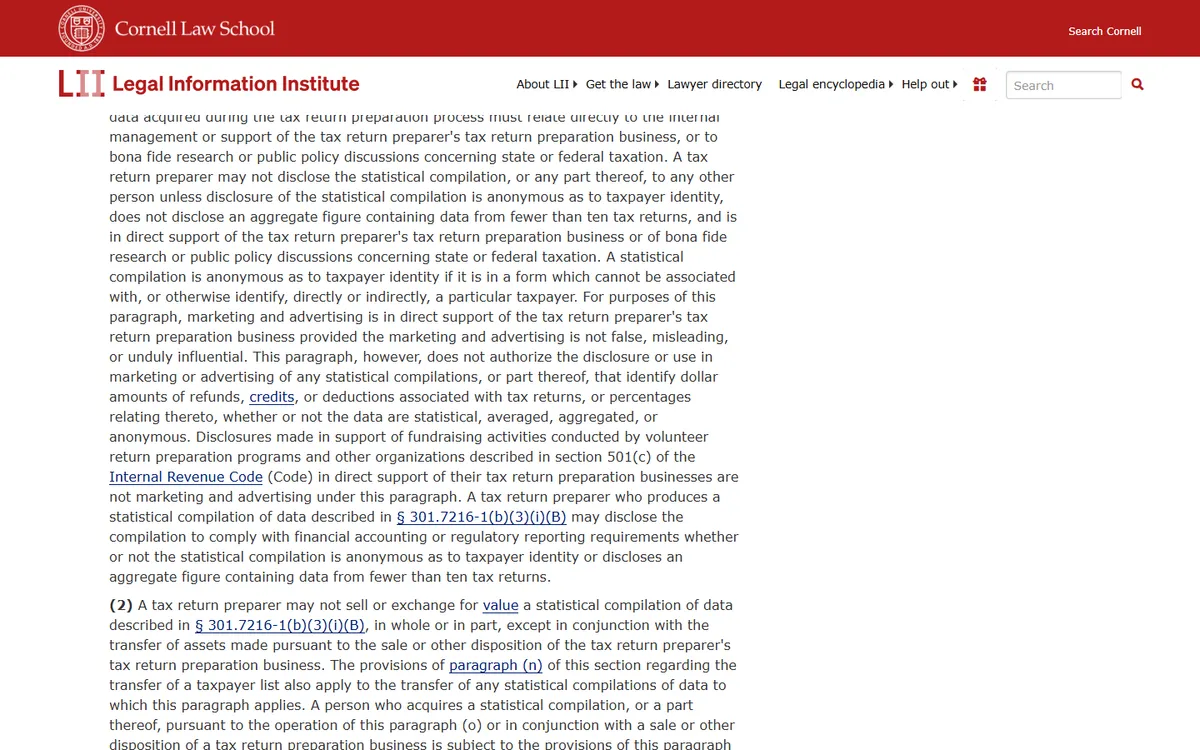
The key rule for data deals is the one on statistical compilations, 26 CFR 301.7216-2(o) (Cornell LII):
- You may compile return data for your own internal management or for bona fide research and public policy discussions.
- You may disclose a compilation only if it's anonymous, includes data from at least 10 returns, and directly supports your tax preparation business (or that research).
- You may not sell or exchange a compilation for value, except as part of selling your tax preparation business.
So anonymizing return data and licensing it to an AI lab for cash runs straight into that prohibition. Using or disclosing return information for that purpose would need the taxpayer's own written consent in the form the IRS prescribes (IRS). In practice, that means each client signing a consent that meets Rev. Proc. 2013-14.
The AICPA rule applies too
CPAs in public practice also have the AICPA Confidential Client Information Rule, which requires the client's specific consent before disclosing confidential client information (Journal of Accountancy). That covers more than tax returns: bookkeeping records, payroll files and advisory work are confidential client information too. Most state boards have similar rules.
What a firm might still be able to license
The rules target client information. Data that's genuinely about your firm and contains no client information is a different question, for example anonymized internal process data such as task durations or workflow steps. But operational records at an accounting firm are usually full of client data: email threads, reconciliation logs, workpapers, invoices. Separating them cleanly is hard, and de-identification claims aren't independently verified (aitrainer.work). Even Nyne's page notes that owning a record doesn't by itself give you permission to license it (Nyne).
Questions to ask before you sign anything
- Does any of this data come from tax return preparation? If yes, assume §7216 applies, including to anonymized compilations.
- What exactly is being collected? Get a list of systems, data types and date ranges in writing.
- How is it de-identified, and who checks? Ask for the method and any independent audit.
- Who are the buyers, and what can they do with it? Ask whether the purpose is limited by contract and whether the data can be resold.
- What do your engagement letters and your WISP say? Your written information security plan and the FTC Safeguards Rule still apply to any vendor that touches client data (our client data rules guide).
- Have you asked your malpractice insurer? A data licensing deal may not be covered conduct.
FAQ
Can a tax preparer sell anonymized client data to AI companies?
Generally no. Under 26 CFR 301.7216-2(o), a preparer may not sell or exchange a statistical compilation of tax return information for value, except as part of selling the tax preparation business. Other uses need the taxpayer's written consent.
What is BizBuyData?
A data-licensing program from Mode.Inc that pays accounting firms with 10 or more employees to license historical operational records to AI labs, according to Accounting Today's October 16, 2026 report.
What's the penalty for violating §7216?
A fine of up to $1,000 (up to $100,000 in cases covered by §6713(b)), up to one year in prison, or both. There's also a $250 civil penalty per unauthorized disclosure.
Sources
Pages we used for this article, checked on or before the update date above.
- Accounting Today · accountingtoday.com
- aitrainer.work · aitrainer.work
- Nyne · nyne.ai
- Cornell LII · law.cornell.edu
- IRS · irs.gov
- Cornell LII · law.cornell.edu
- Journal of Accountancy · journalofaccountancy.com
Changelog: Oct 17, 2026: first published.