

New York Courts' AI Guide for Attorneys: No Disclosure, but Verify Everything (October 2026)

Prices and facts checked October 28, 2026. We don't accept payment for rankings.
On this page
What happened: New York's court system has released a seven-page guide for attorneys titled The Risks of Using Artificial Intelligence in Preparing Court Papers: What Every Attorney Should Know. It was reported on October 27, 2026 (NY Daily Record, amNY). It comes from the court system's Advisory Committee on Artificial Intelligence and the Courts, which Chief Administrative Judge Joseph A. Zayas appointed in 2024.
The short version:
- You can use generative AI to prepare court papers.
- You don't have to disclose it or file a separate AI certification, unless a judge's own rules say otherwise.
- You must verify everything. Signing a filing still certifies it, and you remain responsible for every factual and legal statement in it.
If you practice in New York state courts, here's what the guide says, how it fits with the court rule that took effect in June, and what to change in your firm's process.
Not legal advice. This summarizes press coverage of the guide and the court rules as of October 28, 2026. Read the guide itself and check each judge's part rules before you file.
What the guide says
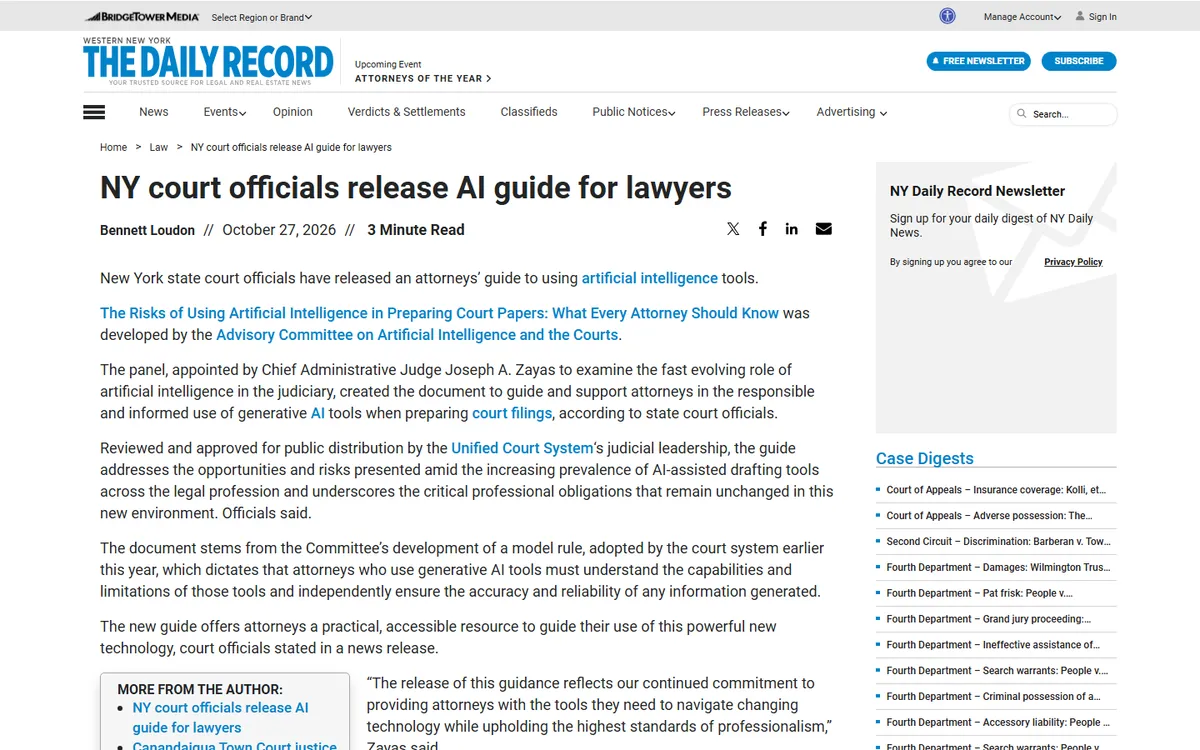
As reported by the NY Daily Record, amNY and Hoodline, the guide (Hoodline):
- explains how AI fails. Generative AI predicts likely words rather than checking facts, so it can produce fake cases, wrong quotations and misleading statements of law. In the guide's words, it's designed to produce text that "sounds right, not text that is right" (amNY).
- asks you to understand the tool's limits. That includes training data that may not reflect recent legal developments and may contain bias.
- tells you to check every citation and quotation against authoritative legal research tools. You should search for, read and analyze each case the AI cites, rather than trusting its summary.
- recommends documenting your verification steps, so you can show what you checked if a filing is questioned.
- says your existing duties haven't changed. The Rules of Professional Conduct and 22 NYCRR Part 130, New York's sanctions rule for frivolous conduct in civil cases, apply the same way whether or not AI was involved.
No disclosure required, with one big exception
The court system chose not to ban AI or require you to disclose it. There's no AI disclosure form or checkbox. Your signature on the filing is the certification (NY Daily Record).
The exception is individual judges. The guide is the default. Judges can still adopt their own AI requirements in their part rules, including disclosure (Hoodline). Check the part rules for every judge on every matter, and recheck them when a case is reassigned.
Not everyone agrees with the no-disclosure approach. New York Law School associate dean Heidi Brown told amNY she found it concerning. She also warned about "misgroundings": AI citing a real case but describing it wrongly. These can be more dangerous than invented cases because they look legitimate (amNY).
How it fits with Part 161, the court rule from June
The guide builds on Part 161 of the Rules of the Chief Administrator. That rule was adopted on March 25, 2026 and took effect statewide on June 1, 2026, in civil and criminal courts (Russo Law via Legal 500):
| Part 161 (in force since June 1, 2026) | The new guide (October 2026) | |
|---|---|---|
| What it is | A court rule | Practical guidance |
| AI allowed? | Yes, consistent with existing duties | Yes |
| Disclosure | Not required statewide | Not required |
| Verification | Review the paper and make sure it has no fabricated cases, statutes or other material | Check every citation and quotation in authoritative sources; document the steps |
| Judges | Courts can adopt a model rule (Appendix A) or their own requirements | Judges' part rules still take priority |
A disclosure bill is still pending
A state bill would go further. Senate Bill S2698 would add a new CPLR Rule 2107 requiring a separate affidavit disclosing generative AI use and certifying that a human reviewed the filing. It has been in the Senate Rules Committee since June 13, 2025, according to the Senate's website (NY Senate). It isn't law. If it passes, the no-disclosure position in the guide would change.
What small firms should do now
- Make verification a written step. For any filing drafted with AI help, have a person pull and read every cited case and statute, and check every quotation word for word.
- Keep a short verification record. Note who checked what and when. The guide recommends documenting these steps, and a record helps if a filing is ever challenged.
- Check for misgroundings, not just fake cases. Confirm each case actually stands for what your brief says it does.
- Check part rules at intake. Add "judge's AI rules" to your new-matter checklist.
- Treat everyone's work the same. Associates, paralegals and contract lawyers may use AI too, and your signature covers their work.
- Update your firm's AI policy. Our free law firm AI policy template has a candor and verification section you can adapt for New York filings.
The court system says its advisory committee is also developing a CLE series, "Artificial Intelligence, Bias, and Equity in Legal Practice" (NY Daily Record). For what happens when verification fails, see our roundup of AI hallucination sanctions cases. For the ethics background, see our guide to ABA Formal Opinion 512. California is taking a different route with a statute: see California SB 574.
FAQ
Do I have to disclose AI use in New York court filings?
Not under the statewide guidance or Part 161. But individual judges can require disclosure in their part rules, so check them for each case. A pending bill, S2698, would require a separate affidavit if it passes.
What does the New York AI guide require attorneys to do?
Understand the AI tool's limits, verify every citation and quotation against authoritative legal research sources, review AI output for bias, and document the verification steps. Attorneys remain fully responsible for every factual and legal statement they file.
What is Part 161?
It's New York's court rule on AI use in court papers. It took effect statewide on June 1, 2026. It allows AI use without blanket disclosure, requires attorneys to make sure filings contain no fabricated material, and lets courts adopt a model rule or their own requirements.
What is a "misgrounding"?
It's when AI cites a real case but misstates what it says or how it applies. Because the citation is real, it can get past a quick check. The fix is to read every case you cite.
Sources
Pages we used for this article, checked on or before the update date above.
- NY Daily Record · nydailyrecord.com
- amNY · amny.com
- Hoodline · hoodline.com
- Russo Law via Legal 500 · legal500.com
- NY Senate · nysenate.gov
Changelog: Oct 28, 2026: first published.