

The SEC Says Don't Wait for AI Guidance. What That Means for Advisers (October 2026)

Prices and facts checked October 21, 2026. We don't accept payment for rankings.

On this page
What happened: on October 16, 2026, Brian Daly, director of the SEC's Division of Investment Management, told advisers to "enthusiastically innovate" with AI "in a responsible and thoughtful manner", and added: "don't wait for regulators to hold your hands through this shift, because you may receive guidance that is both too limited and too late" (SEC).
Why it matters: this confirms that no AI-specific rule for advisers is coming soon. The SEC already withdrew its proposed predictive data analytics rule (our explainer). Responsibility sits with your firm, under the rules you already follow: fiduciary duty, the compliance rule, the Marketing Rule, recordkeeping and Regulation S-P. And examiners are already asking about it.
Not legal or compliance advice. A speech by SEC staff isn't a rule or formal guidance. Talk to your compliance consultant or counsel about your firm's specific AI uses.
What the director actually said
In remarks at the Stanford University Private Capital Roundtable, most of which covered retail access to alternative investments, Daly turned to AI (SEC):
- AI is welcome. He called it "a unique opportunity for regular folks to gain access to vast expertise, including investment expertise", and described the current SEC as "the most pro-innovation SEC ever".
- The industry is too cautious. He said there is "far more trepidation" about deployment than he thinks is warranted.
- Existing duties still apply. "Our principles-based, fiduciary duty regime adapted to the invention of television, email, the internet, and smartphones; it will adapt" to AI. Fiduciaries "have duties of care and loyalty, and progress can be consistent with both of them."
- Don't wait for guidance. Guidance may be "too limited and too late".
- Tell the SEC about real roadblocks. If specific laws, rules or staff positions are "actually preventing" advisers from deploying these tools, "we want to hear about them."
This continues a theme. In February 2026, Daly described a "request for engagement" and invited firms to raise concerns about how existing rules constrain new technology (SEC).
Why the SEC now says "SI" instead of "AI"
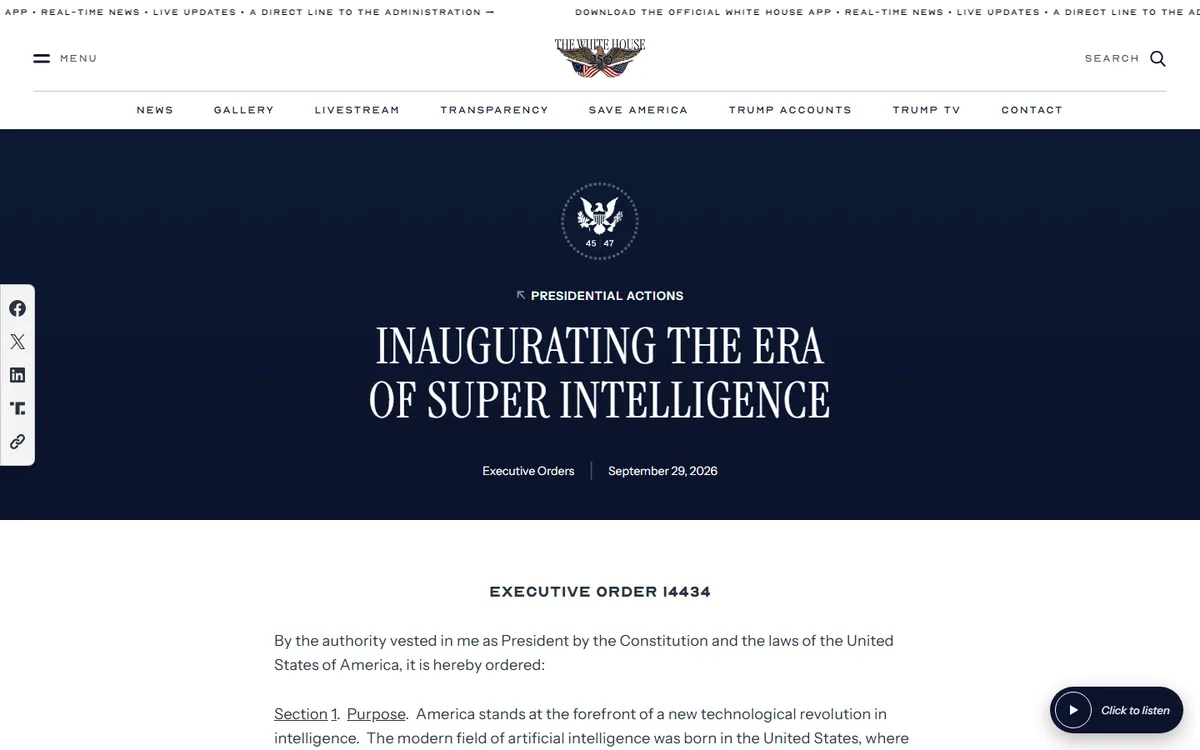
In the speech, Daly refers to "Super Intelligence" (SI), not AI. That follows Executive Order 14434, signed September 29, 2026, which tells federal agencies to use "Super Intelligence" and "SI" in place of "artificial intelligence" and "AI" in their communications and non-statutory documents. It defines SI by reference to the existing statutory definition of AI and doesn't change any existing regulations or apply to private parties (White House). For your firm, nothing changes: expect to see "SI" in SEC speeches and documents, meaning the same thing as AI.
What examiners are already asking
"Don't wait" cuts both ways: no new rules, but no grace period either.
- It's an exam priority. The SEC's 2026 exam priorities include the "training and security controls" firms use to manage AI risks, with a focus on Regulation S-P compliance, which took full effect in June 2026 (Kitces; our exam priorities guide).
- Training and supervision. Kitces reports the SEC is "reportedly taking an interest" in how advisers train and supervise employees on AI, and compares the risk to the off-channel communications fines of recent years. It also notes the SEC hasn't announced any discipline over employee AI use so far (Kitces).
- The documents examiners look for, per Financial Advisor magazine's August 2026 reporting (FA Magazine):
- minutes and decisions from any AI committee
- an inventory of approved AI tools, including AI built into vendors' products
- written policies covering supervision of AI use
- client data handling under Regulation S-P, and documented human review of AI output
- staff training records
- controls on "shadow AI" (staff using unapproved tools)
- evidence that marketing claims about AI are accurate
The same article notes there's no SEC rule requiring a standalone AI policy. But the compliance rule still requires policies reasonably designed to prevent violations, and they need to cover how your firm actually uses AI. "AI washing" is a real risk too: the SEC settled cases against Delphia and Global Predictions in 2024 for a combined $400,000 over misleading AI claims (FA Magazine).
Where most firms are
The gap the SEC describes is real. At WealthManagement's RIA Edge conference this week, Celent's Ashley Longabaugh said 63% of RIAs use AI, double the 2024 level, but only 1 in 10 use it as a fully integrated part of their business strategy. One panelist put it bluntly: "Failure to launch is a leadership issue; it's not necessarily a tech issue" (WealthManagement.com).
What "don't wait" looks like for a small RIA
A practical checklist that matches what examiners are asking for:
- List every AI tool in use, including AI features inside your CRM, planning software and notetaker. Mark each approved or not approved.
- Write a short AI section into your compliance manual: approved tools, what client data may go into them, required human review, and who signs off on new tools.
- Vet vendors under Regulation S-P: where data is stored, whether it trains models, retention and deletion. See our Regulation S-P and AI vendors guide.
- Keep the records: meeting notes and summaries from AI notetakers can be books and records (AI notetaker recordkeeping).
- Train staff, and keep proof. A one-page acknowledgment plus a short annual session is a reasonable baseline.
- Check marketing claims. If your website or pitch book mentions AI, make sure it's accurate and you can support it (AI marketing rules).
- Review it twice a year. Tools change fast, and so does what examiners ask.
Then innovate. The director's message is that a well-documented, supervised AI rollout is what the SEC wants to see. For where AI tools for advisors are heading, see AI agents for financial advisors and M1's AI-only advisor.
FAQ
Is there an SEC rule on AI for investment advisers?
No. There's no AI-specific rule, and the SEC withdrew its proposed predictive data analytics rule. Existing obligations apply instead: fiduciary duty, the compliance rule, the Marketing Rule, recordkeeping and Regulation S-P.
What did the SEC's investment management director say about AI?
On October 16, 2026, Brian Daly urged advisers to innovate responsibly and said: "don't wait for regulators to hold your hands through this shift, because you may receive guidance that is both too limited and too late." He invited firms to report specific rules that block AI use.
Why does the SEC say "Super Intelligence" instead of AI?
Executive Order 14434 (September 29, 2026) directs federal agencies to use "Super Intelligence" and "SI" instead of "artificial intelligence" and "AI" in their communications. It doesn't change existing regulations or apply to private firms.
Do RIAs need a written AI policy?
There's no rule requiring a standalone AI policy. But your compliance policies must be reasonably designed to prevent violations, so they should cover how your firm actually uses AI, including approved tools, client data and supervision.
Sources
Pages we used for this article, checked on or before the update date above.
- SEC · sec.gov
- SEC · sec.gov
- White House · whitehouse.gov
- Kitces · kitces.com
- FA Magazine · fa-mag.com
- WealthManagement.com · wealthmanagement.com
Changelog: Oct 21, 2026: first published.