

AI Use Policy Template for Insurance Agencies (Free, 2026): Most Agencies Still Don't Have One

Prices and facts checked October 28, 2026. We don't accept payment for rankings.

On this page
The gap: 45% of independent agencies use ChatGPT or other public AI chatbots, but only 13% have a formal AI use policy. Another 55% have no written policy at all, according to the Big "I" Agents Council for Technology (ACT) 2026 Tech Trends Report (Big "I", Insurance Journal).
Why it matters now:
- Regulators are watching AI. The NAIC's AI model bulletin has been adopted in 29 jurisdictions (NAIC adoption map). It's aimed at insurers, but carriers are passing its expectations down to the agencies they work with. The NAIC's AI exam tool also goes to a vote this fall; see our guide to the NAIC AI evaluation tool.
- Clients are using AI too. Carriers now sell inside ChatGPT, and J.D. Power found 29% of auto and home customers have used AI for insurance tasks (Insurance Business).
- Your staff are already using it. Two-thirds of agencies plan to use AI more over the next 12 months (Carrier Management).
ACT's own advice is to treat AI "like a junior colleague" that needs supervision on complex or high-impact work (Insurance Journal). A written policy is how you set that supervision up. Below is a template you can adapt in an afternoon.
A starting point, not legal advice. Check it against your state's insurance and privacy laws, your carrier agreements and your E&O carrier's requirements. Fill in every bracketed field.
What agencies are worried about
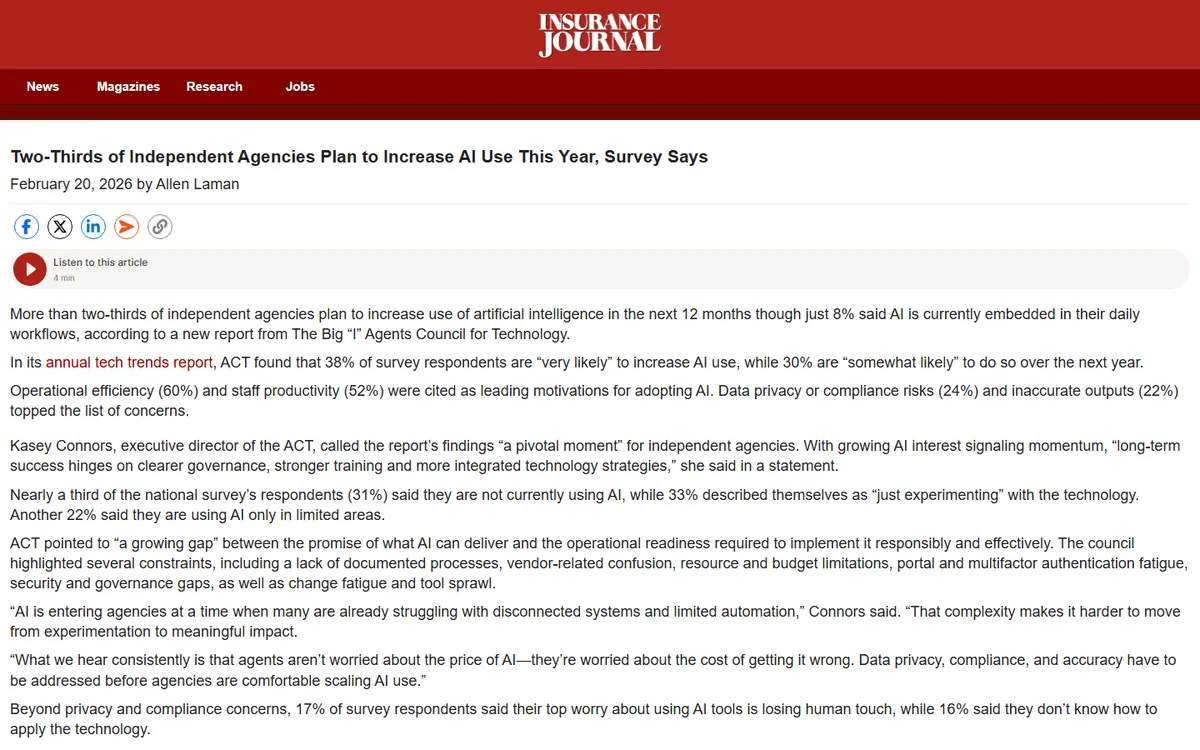
The ACT survey's top concerns map directly onto what a policy should cover (Big "I"):
| Agencies' top AI concern | Share | Policy section that addresses it |
|---|---|---|
| Data privacy or compliance risks | 24% | 3 (client data), 4 (vetting tools) |
| Inaccurate outputs | 22% | 5 (human review) |
| Losing the human touch | 17% | 5, 6 (licensed staff stay responsible; AI disclosure) |
| Not knowing how to apply AI | 16% | 9 (training) |
Training is a weak spot too: almost 44% of agencies rely mostly on peer-to-peer learning for new tools (Carrier Management).
The template
[Agency name] Policy on the Use of Artificial Intelligence
Effective date: [date] · Policy owner: [name, role] · Next review: [date, no more than 12 months away]
1. Purpose and scope. This policy covers every use of artificial intelligence (AI) tools, including chatbots, AI receptionists, AI features in our agency management system and carrier portals, and AI agents. It applies to all producers, CSRs, account managers, staff and contractors, on agency or personal devices.
2. Approved tools. Only tools on the agency's approved list may be used for agency or client work. The current list is: [tool name, plan/tier, approved uses]. Personal or free AI accounts may not be used with client information. To request a new tool, ask [policy owner], who will review it under section 4.
3. Client data. Never enter the following into a tool that is not on the approved list: Social Security numbers, driver's license numbers, dates of birth, health or medical information, claims details, loss runs, financial statements, payment or bank details, or anything a client has asked us to keep confidential. When using an approved tool, enter only the information needed for the task.
4. Vetting a tool. Before approval, the policy owner confirms in writing:
- whether the vendor uses our data to train its models (approved tools must not);
- how long the vendor keeps our inputs and outputs, and how they are deleted;
- where our data is stored and who at the vendor can access it;
- the vendor's security measures, including any independent certification such as SOC 2;
- whether connecting it to a carrier portal or our agency management system is allowed under our carrier agreements;
- what happens to our data if we stop using the service.
5. Human review. A licensed person is responsible for everything we send to a client or carrier, whoever or whatever drafted it. AI may draft, summarize and compare, but:
- no AI tool may bind coverage, make a coverage recommendation, or tell a client they are or aren't covered without a licensed person's review and approval;
- every AI-prepared application, submission, proposal or coverage comparison is checked against the policy forms, the carrier's quote and the client's information before it goes out;
- every AI-written client email or letter is read before it's sent.
6. Client communication. When clients interact with an AI chatbot or receptionist, it identifies itself as automated and offers a way to reach a person. We don't use AI to imitate a specific staff member's voice or identity.
7. Calls, texts and marketing. AI-generated voices count as artificial voices under the TCPA. We make AI voice calls or send automated texts only with the consent the law requires, and we honor opt-outs promptly. AI-written marketing is reviewed for accuracy and for compliance with our carriers' advertising rules before it is published.
8. Records. AI-assisted work on client files is saved to the client's record in [agency management system], with a note of who reviewed it. Keep a log of AI tools in use and what they're used for.
9. Training. Everyone covered by this policy completes AI training when they join and at least [annually], covering this policy, approved tools, data rules and common AI errors.
10. Incidents. If client information goes into an unapproved tool, or an AI error reaches a client or carrier, report it to [policy owner] immediately. The agency will assess any notice duties under state law and our carrier and E&O obligations.
11. Review. The policy owner reviews this policy and the approved tool list at least every [12] months, and whenever we adopt a tool that can act on its own, such as an AI agent that works in carrier portals.
Acknowledged by: ______________________ Date: __________
Why each section is there
Approved tools and client data (sections 2–4). Data privacy is agencies' top AI concern, and 45% use public chatbots (Big "I"). The biggest risk is a CSR pasting a loss run or a driver's details into a personal ChatGPT account. A short approved list with business-grade plans fixes most of it. Carrier agreements matter as well. If an AI tool logs into carrier portals with your credentials, check that it's allowed. We cover this in our look at Bind AI's AI workforce for commercial agencies.
Human review (section 5). Inaccurate output is the second-biggest concern. An AI error on an application or a coverage comparison is still your agency's error, and your E&O carrier will treat it that way. A named reviewer and a saved record (section 8) are your evidence that a licensed person checked the work.
AI disclosure and calls (sections 6–7). In February 2024, the FCC confirmed that the TCPA's limits on "artificial or prerecorded voice" calls cover AI-generated voices, so those calls need the called party's prior express consent (FCC). Our guide to AI voice calls and the TCPA covers the consent rules in detail.
Carriers and regulators (all sections). The NAIC bulletin asks insurers to govern the AI systems they use, including third-party ones. Carriers increasingly ask their agencies how they use AI. A written policy is an easy answer. See what the NAIC bulletin means for agencies.
How to roll it out in a week
- List what's in use. Ask every staff member which AI tools they use, including free ones on their phones. Expect surprises.
- Pick the approved tools. Choose one general assistant on a business plan that doesn't train on your data, plus any AI built into your agency management system, receptionist or quoting tools.
- Fill in the brackets and have everyone sign it.
- Train for 30 minutes. Walk through sections 3 and 5 with real examples from your book: what can go into the chatbot, and what a licensed person checks.
- Tell your E&O carrier you have a policy, and ask if they'd like any changes.
- Put the review date in the calendar.
If you're choosing tools now, see our guides to the best AI receptionists for insurance agencies and the best agency management systems for small agencies.
FAQ
Do insurance agencies need an AI use policy?
No law requires one for most agencies yet, but carriers, regulators and E&O insurers increasingly expect one. Only 13% of independent agencies have a formal AI policy, according to the Big "I" ACT's 2026 Tech Trends Report.
Can insurance agents use ChatGPT with client information?
Only on a business plan your agency has approved, where the vendor doesn't train on your data, and only with the minimum information needed. Don't put Social Security numbers, health information, claims details or payment data into personal or free AI accounts.
Who is responsible if AI makes a mistake on a client's coverage?
The agency and the licensed person who sent it. That's why the template requires a licensed person to review any AI-prepared application, comparison or coverage statement before it reaches a client or carrier.
Do AI phone calls to prospects need consent?
Yes. The FCC confirmed in 2024 that AI-generated voices count as artificial voices under the TCPA, so those calls require the called party's prior express consent.
Sources
Pages we used for this article, checked on or before the update date above.
- Big "I" · independentagent.com
- Insurance Journal · insurancejournal.com
- NAIC adoption map · content.naic.org
- Insurance Business · insurancebusinessmag.com
- Carrier Management · carriermanagement.com
- FCC · fcc.gov
Changelog: Oct 28, 2026: first published.