

AI Scribes in Therapy Sessions: The New State Consent Laws (Colorado, Rhode Island, Louisiana)

Prices and facts checked October 13, 2026. We don't accept payment for rankings.

On this page
What happened: three states this summer wrote AI note-taking into law. Colorado's HB 26-1195 took effect August 12, 2026 and requires written, informed consent before AI records or transcribes a psychotherapy session (Colorado General Assembly). Rhode Island enacted three AI laws on June 22, 2026, including written consent for AI use in recorded therapy sessions and notice for AI scribes generally (Transparency Coalition). Louisiana's Act 649 has required verbal disclosure before AI-transcribed recording since August 1, 2026 (Arnall Golden Gregory).
Why it matters today: if you use an AI scribe like Upheal, Mentalyc or SimplePractice's note tools, your consent process is now a legal requirement in more states, not just good practice. And because these laws follow where the client is, telehealth practices must meet the rules of every state they serve.
Not legal advice. Check the enacted text and your licensing board's guidance before relying on this summary.
The laws side by side
| State | Law | In force | What it requires |
|---|---|---|---|
| Colorado | HB 26-1195 | Aug 12, 2026 | Advance disclosure of AI use and purpose; written, informed consent to record or transcribe; revocable; no denial of services if declined; tell clients about AI restrictions at first contact |
| Rhode Island | S 2197 / H 7349 | Jun 22, 2026 | Written consent before AI assists therapeutic communication in recorded or transcribed sessions; no AI treatment decisions or plans |
| Rhode Island | S 2570 / H 7538 | Jun 22, 2026 | Notify patients when AI documents a visit (in person or telehealth); review AI documentation for accuracy |
| Louisiana | Act 649 (La. R.S. 37:22.1) | Aug 1, 2026 | Verbal disclosure before recording any part of an appointment AI will transcribe; covers mental health and other licensed professions |
| Illinois | WOPR Act | Aug 2025 | Written, revocable consent for AI supplementary support involving recorded sessions |
Sources: Colorado General Assembly; Snell & Wilmer; Nixon Peabody; Transparency Coalition; Arnall Golden Gregory.
Colorado in detail
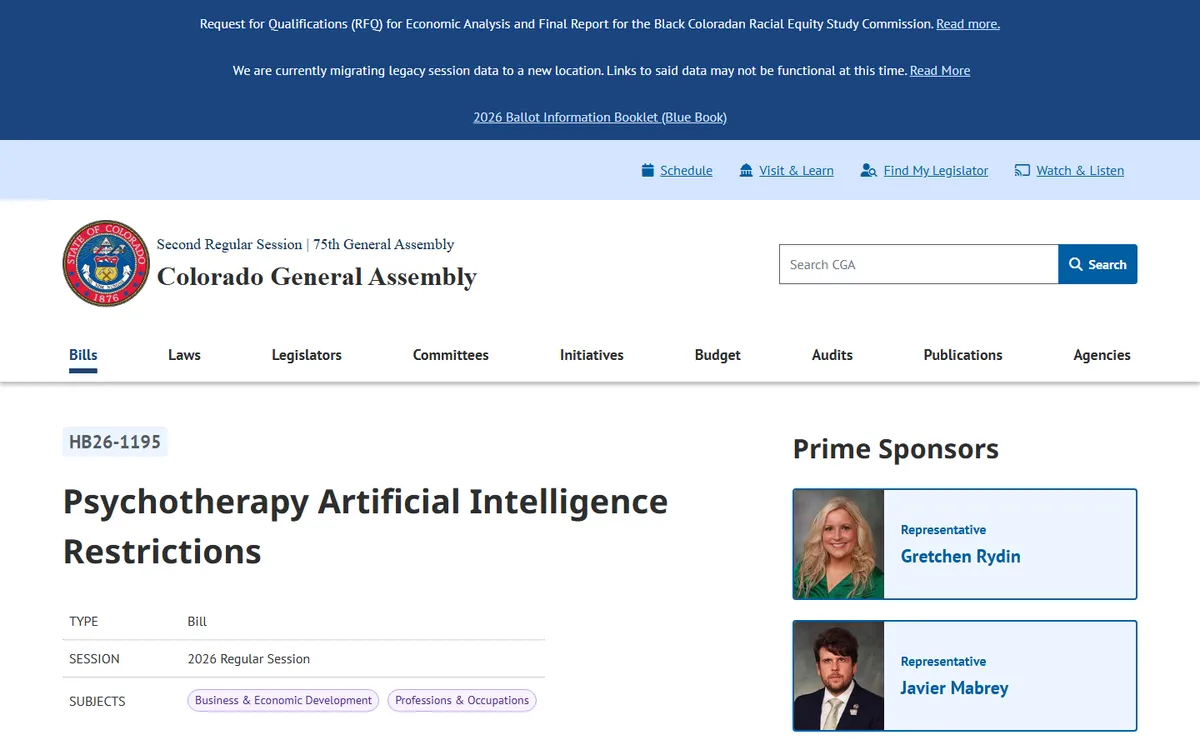
Under HB 26-1195, a psychotherapy provider must (Snell & Wilmer):
- get clear, written, revocable consent before AI records or transcribes. One-time consent is enough unless the purpose or method materially changes
- not deny services to a client who refuses or revokes consent
- review and approve any AI-generated treatment recommendations or plans
- not let AI hold therapeutic conversations unless the provider is present in real time
Penalties: licensing discipline, administrative fines up to $5,000, and civil penalties up to $20,000 under the Colorado Consumer Protection Act. Providers aren't liable for defects attributable to the AI's developer.
Consent vs disclosure
- Consent states (Colorado, Rhode Island for therapy, Illinois): the client must agree in writing before recording.
- Disclosure states (Louisiana): you must tell the client before recording; consent isn't required by that law, though recording-consent laws may still apply.
- Everywhere: HIPAA, your BAA with the vendor, and all-party recording consent laws in some states still apply (our HIPAA consent guide).
Simplest approach: use written consent everywhere. It satisfies the strictest states and builds client trust.
A consent workflow that covers all of these
- Intake form: a separate AI note-taker consent explaining what's recorded, why, where it's stored, how long, and that the client can say no or change their mind.
- First session: say it out loud too (this covers Louisiana's verbal disclosure) and note it in the chart.
- Offer a no-AI option with no change to care.
- Re-consent if you change tools or start using AI for something new.
- Review every AI note for accuracy before signing (Rhode Island requires it, and it's good practice).
- Record revocations immediately and switch off the scribe for that client.
- Check your vendor's settings: audio deletion after note approval, no training on client data, signed BAA.
Choosing a tool? See our AI progress notes comparison. For the broader picture of AI therapy bans, see state AI therapy laws.
FAQ
Does Colorado require consent for every session?
No. One-time written consent is enough unless the purpose or manner of AI use materially changes.
Can I require AI scribe consent as a condition of treatment?
Not in Colorado, and conditioning care on consent is risky everywhere. Offer a no-AI path.
My client is in another state for a telehealth session. Whose law applies?
Generally the client's location. Apply the strictest rule that could apply.
Sources
Pages we used for this article, checked on or before the update date above.
- Colorado General Assembly · leg.colorado.gov
- Transparency Coalition · transparencycoalition.ai
- Arnall Golden Gregory · agg.com
- Snell & Wilmer · swlaw.com
- Nixon Peabody · nixonpeabody.com
Changelog: Oct 13, 2026: first published.