

Should Your AI Notetaker Record Opposing Counsel? NYC Bar Opinion 2026-2 Says Usually Not

Prices and facts checked October 13, 2026. We don't accept payment for rankings.
On this page
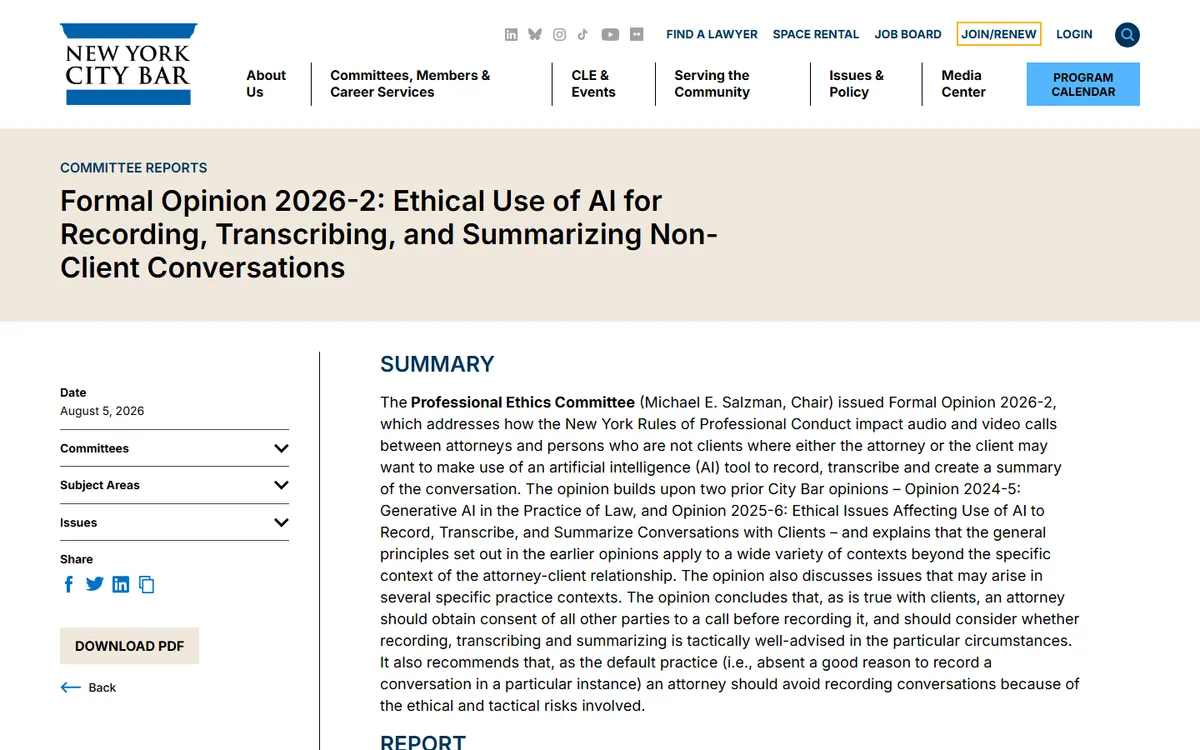
What happened: in August 2026, the New York City Bar Association's ethics committee issued Formal Opinion 2026-2, on using AI tools to record, transcribe and summarize calls with non-clients: opposing counsel, witnesses, co-counsel, prospective clients and investigators. Its bottom line: get consent from all other parties, and "the default practice should be not to record" (NYC Bar).
Why it matters today: AI notetakers now join Zoom and Teams calls automatically. Without a policy, your firm may be recording conversations it shouldn't, and creating discoverable transcripts.
Not legal advice. NYC Bar opinions are advisory and interpret New York's rules. Check your own jurisdiction's rules and recording-consent laws.
The three-opinion series
| Opinion | Date | Topic |
|---|---|---|
| 2024-5 | Aug 2024 | Generative AI in practice: confidentiality, verification, informed consent before sharing client data (NYC Bar) |
| 2025-6 | Dec 2025 | AI recording of client calls: get consent, review accuracy, know how to turn recording off (NYC Bar) |
| 2026-2 | Aug 2026 | AI recording of non-client calls |
What 2026-2 says
- Consent from everyone before recording, and no surreptitious recording (Rule 8.4).
- Consider tactics: is recording actually wise here?
- Default: don't record without a good reason in the particular case.
- Competence (Rule 1.1): understand how the tool records, stores and shares, and know how to turn it off.
- Review transcripts for accuracy, which adds cost.
- Loss of control: if another participant runs their own AI tool, you can't control security, accuracy or access.
Sources: NYC Bar; NYC Bar press release, Aug 17, 2026.
Situation by situation
| Who's on the call | Guidance |
|---|---|
| Co-counsel | Limit access to recordings and summaries to protect privilege; address recording in joint defense or common interest agreements |
| Prospective clients (Rule 1.18) | Default: don't record. Recordings create information-sharing and conflict risks |
| Opposing counsel | Take care with settlement talks and mediation privileges and client confidentiality |
| Witnesses (Rules 3.4, 4.2, 4.3) | Default: don't record. Recordings may be discoverable and risk work product |
| Investigators and agents | Risks generally outweigh benefits; how consent is obtained raises questions |
Source: NYC Bar Formal Opinion 2026-2. The opinion notes an exception: a lawyer with a hearing impairment may find AI transcription warranted, with consent.
Don't forget recording-consent laws
Ethics rules sit on top of wiretap laws. New York is generally one-party consent, but other states require all-party consent, and some treat voiceprints as biometric data (NYC Bar 2025-6). A multi-state call means following the strictest rule.
Also: what you record can become evidence
A February 2026 federal ruling held that a client's own AI-generated analysis wasn't privileged (BakerHostetler; our Heppner explainer). AI transcripts of non-client calls are even less likely to be protected.
A simple firm policy
- AI notetakers off by default in Zoom, Teams and Meet for all external calls.
- Client calls: record only with consent, per 2025-6.
- Non-client calls: record only with partner approval, a documented reason and everyone's consent.
- Never record prospective clients, witnesses or investigators' interviews with AI by default.
- Ask at the start of calls whether anyone else is using an AI notetaker, and object if needed.
- Store transcripts like privileged files, with retention rules.
For the national framework, see ABA Formal Opinion 512.
FAQ
Is 2026-2 binding outside New York City?
No. It's an advisory opinion, but it's influential, and its reasoning applies to similar rules elsewhere.
What if opposing counsel's AI bot joins the call?
You can ask for it to be removed or object on the record. The opinion flags that you lose control over another participant's tool.
Can I record a deposition prep session with a witness?
The opinion's default is not to record witnesses, given discoverability and work-product risks.
Sources
Pages we used for this article, checked on or before the update date above.
- NYC Bar · nycbar.org
- NYC Bar · nycbar.org
- NYC Bar · nycbar.org
- NYC Bar press release, Aug 17, 2026 · nycbar.org
- BakerHostetler · bakerlaw.com
Changelog: Oct 13, 2026: first published.